
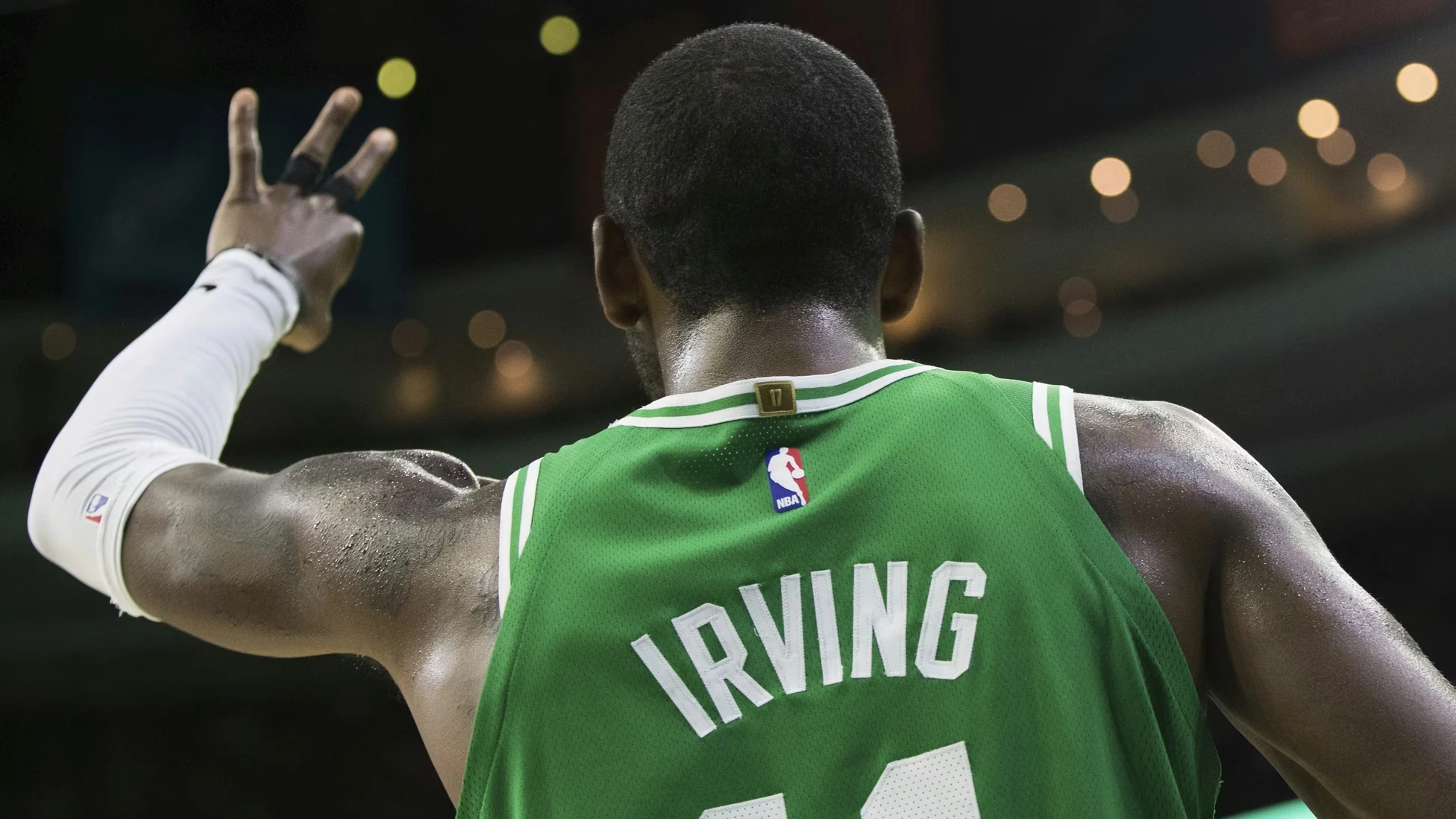
The Politics of “Being Difficult”: Kyrie Irving and the Limits of Being Free

One of the most gifted and controversial players in contemporary basketball, NBA champion Kyrie Irving has been an outspoken advocate for social justice, while also drawing widespread criticism for his stance on Covid-19 vaccination and conspiracy theories. But what connects these seemingly contradictory sides of his public image? Starting from Irving’s career and his repeated clashes with the institutions that govern professional basketball, this article explores the politics of individual freedom in the age of player empowerment.
At four years old, Kyrie Irving wrote a promise on a piece of paper: I will play in the NBA. He did.
At 34, he is a nine-time All-Star, an NBA champion and one of the most recognizable players of his generation. In 2020, his fellow players elected him vice president of the National Basketball Players Association (NBPA), the union representing NBA players in their dealings with the league. By any conventional measure, Kyrie Irving made it.
But his career is difficult to describe without mentioning the things that happened beyond basketball. He asked the public to consider whether the Earth might be flat (then said sorry). He refused to get vaccinated against Covid-19, knowing he could miss games. And in 2022, he shared a link on social media to “Hebrews to Negroes: Wake Up Black America”, a film that numerous media outlets have described as promoting antisemitic theories.
The same player who has supported social justice causes, donated millions of dollars and spoken extensively about spirituality and purpose has also made choices that have drawn widespread criticism. That is what makes Irving such a difficult subject. The contradictions are not confined to one episode or one period of his career.
In September 2026, after nineteen months away from the court following a torn ACL in his left knee, Irving returned to the Dallas Mavericks. At Media Day, he described the injury as “probably the best thing” that had happened to him. The time away, he said, had given him an opportunity to reflect on “how to be a better player, but most importantly, how can I be a better man.” Irving doesn’t want to only be a successful basketball player. He has repeatedly tried to decide for himself how he should live, what he should believe and how much authority other people should have over those decisions.
The “magician with the ball”
To understand why Kyrie became so powerful, you first have to understand why he was given so much leeway.
Basketball is a sport in which talent can take on an almost aesthetic quality. Some players dominate through their size, strength or speed. Kyrie has always seemed to be playing a slightly different game. He could change direction without warning, stop his body mid-drive, send the ball behind his back and between his legs with such ease that, at times, it looked as though the basic laws of gravity simply did not apply to him. His peers gave him a fitting nickname: the “magician with the ball.”
And then, in 2016, the Cleveland Cavaliers faced the Golden State Warriors in the NBA Finals, the series that determines the league champion. Golden State arrived looking almost untouchable, having won 73 of its 82 regular-season games: an NBA record at the time. To win the title, Cleveland needed four victories. After the first four games, it had just one. Down 3–1, the Cavaliers had no room left for error: they had to win the final three games to take the series. No NBA team had ever come back from a 3-1 deficit in the Finals. In Game 7, with less than a minute left and the score tied, Kyrie got the ball with Stephen Curry in front of him. A few seconds later, he pulled up for a three. Cleveland won its first NBA championship.
The shot instantly became part of American basketball lore. The four-year-old who had written down his promise had just kept it in front of millions of people.
Being “difficult”
For all his brilliance, Kyrie has always been difficult.
At first, that difficulty looked a lot like the personality of a superstar. He did not want to be the second-best player on his own team. He wanted his own team, his own role, his own sense of where his career was headed. In Cleveland, playing alongside LeBron James, he ultimately accepted a different arrangement: he became the franchise’s second star, and together they won the 2016 championship.
Then he left Cleveland for Boston, where he lasted just two seasons before asking out. In 2019, he moved to Brooklyn, joining Kevin Durant on a team built around the ambitions of two superstars. On paper, it was almost too perfect: a New York franchise, two of the league’s most talented players, enormous media attention and a championship in sight.
Brooklyn, specifically, exposed the tension at the heart of Kyrie’s career. He wanted to compete at the highest level and be part of something bigger than himself, but he also wanted to decide for himself how that participation would look. When the team, the role or the rules of the collective no longer suited him, Kyrie had a tendency to push back rather than simply fall in line. Eventually, after another turbulent chapter in Brooklyn, he left for Dallas in 2023.
During his season in Brooklyn, Kyrie was also questioning something more fundamental: how much control should a player actually have over his own career? On an episode of The Ryen Russillo Podcast released in January 2021, journalist Jackie MacMullan recalled a conversation she had had with Irving roughly two years earlier, while he was in Brooklyn. They were discussing the power franchises hold over players, and Irving challenged the logic of the NBA Draft itself: why, he asked, couldn’t players simply choose where they wanted to play? “We’re not someone’s property,” he reportedly told her. MacMullan’s response was blunt: “Yeah you are, dude. That’s the way it works, that’s why you get paid all these millions.” Then Covid arrived. And suddenly, that question was no longer theoretical.
Recruited by the right
When New York City introduced a vaccine mandate for people working in certain public spaces, Kyrie Irving refused to get vaccinated. The consequence was immediate: he could not play home games for the Brooklyn Nets. A team built to win a championship was suddenly missing one of its two stars.
The controversy was quickly framed as a question of individual autonomy. Irving was refusing to let an institution or a public policy determine what he should do with his own body. But that idea of freedom was colliding with another one: the principle of collective responsibility during a public-health crisis. Irving could have accepted the consequences quietly. Instead, the refusal became a defining position. And with it, his public image began to shift.
Until then, he could still be understood primarily through the familiar image of the socially conscious athlete: the player who supported Black Lives Matter, traveled to Standing Rock to stand with Indigenous protesters against the Dakota Access Pipeline, and publicly supported WNBA players and other athletes fighting for social justice. Now, a very different audience was claiming him. Conservative figures including Senator Ted Cruz and Donald Trump Jr. defended him. Anti-vaccine protesters gathered outside Barclays Center to support him.
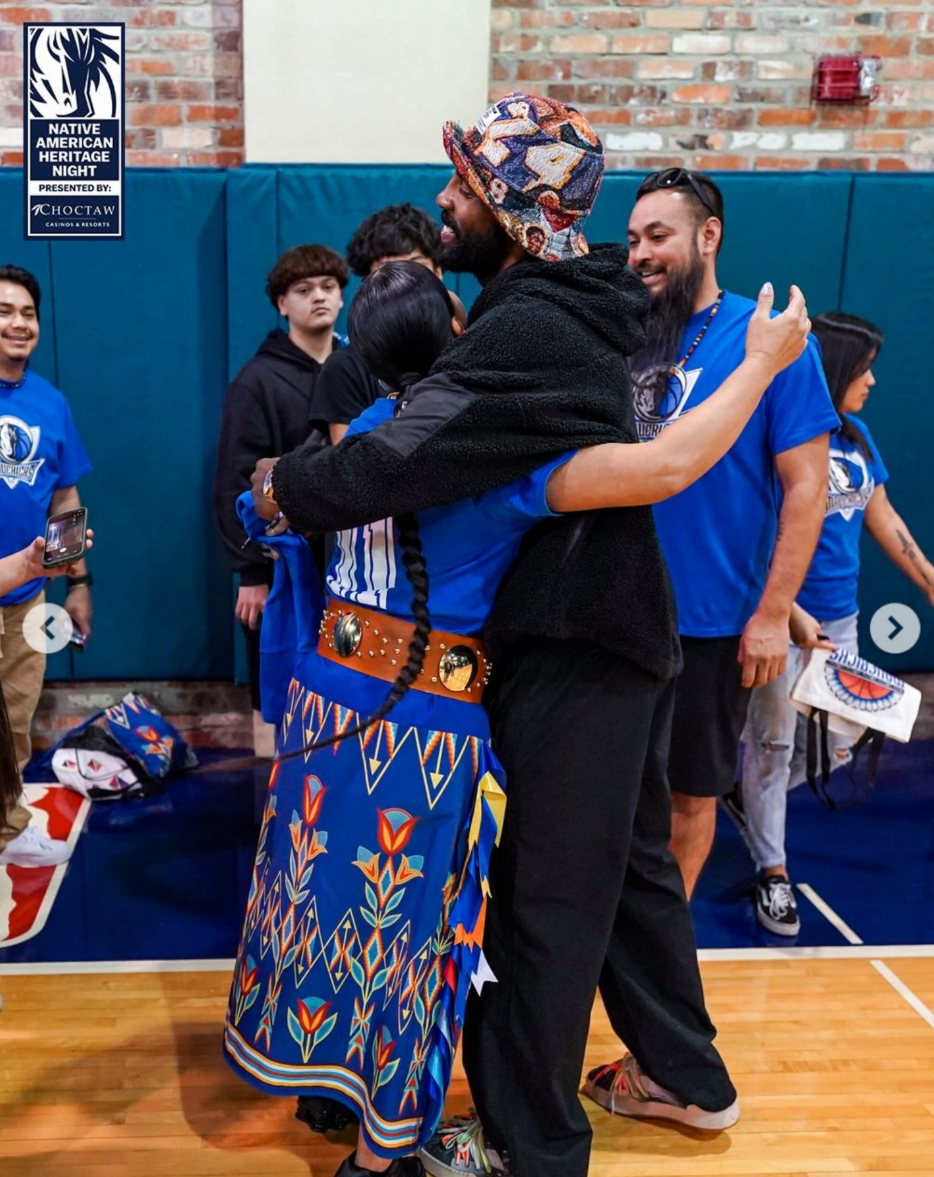
The alliance was unexpected. Nothing in Irving’s previous record made him an obvious fit for this political constituency. He did not appear to have adopted a new ideology so much as followed an old instinct into unfamiliar territory: resisting institutions, questioning authority and insisting on making his own decisions. For some on the right, that was enough. Irving had become a symbol of individual liberty without necessarily becoming a conservative.
But Irving has never seemed interested in belonging to a political camp, because his positions do not always add up to a coherent political worldview. What appears to matter more to him is the belief that there is a purpose behind what he does, something larger than himself. “There’s a purpose I lace up these shoes for, and it’s bigger than me,” he once said.
It complicates the easiest reading of his controversies. Irving does not appear to be someone who simply does not care about the consequences of his actions. He appears to care deeply about living according to what he believes to be true. The problem is that conviction and truth are not the same thing.
Taking freedom (too) literally
When I started writing about Kyrie Irving, I was tempted to tell the story of a courageous athlete who simply refused to shut up. That would have been too easy. The other version, the narcissistic star who torched his own career by falling down one conspiracy rabbit hole after another, is just as easy to tell. Both make for a compelling story and both are already out there, waiting for you to read them. But neither, in my opinion, quite gets at what makes Irving so difficult to pin down: his contradictions.
He is, in many ways, a remarkably pure product of the world professional basketball helped create: a world in which athletes gained an unprecedented ability to speak for themselves while becoming media platforms in their own right. The NBA taught its stars that they could be more than players: they could be brands, entrepreneurs, activists, businessmen, public intellectuals. They could speak beyond the narrow role traditionally assigned to them. And Kyrie took that promise seriously… Perhaps more seriously than anyone expected. He understood player empowerment not simply as the right to choose a team or control his career, but as something broader: the right to say no, to question the institution, to disappear, to change his mind, to follow a conviction or a belief wherever it takes him.
That may be related to the fact that he is deeply spiritual. He appears genuinely committed to living according to his convictions. He has given generously, supported causes that mattered to him and repeatedly used his platform to speak about people and communities beyond himself. None of that makes him infallible. He can be generous and irresponsible, perceptive on one subject and spectacularly wrong on another. He can ask legitimate questions and then place far too much faith in the answers he finds for himself.
Perhaps the only thing one can reproach Kyrie for is taking the promise of freedom quite literally: if you have the right to think for yourself, you must also have the right to think badly, dissent loudly, change your mind and refuse the script. But freedom has a less glamorous companion: responsibility.