
Where Memory Dwells Like Mangroves. A Conversation with Akinola Davies Jr.

Starting from his film My Father’s Shadow, set in Lagos in 1993, Akinola Davies Jr. reflects on how memory, both personal and collective, shapes the way he approaches cinema. Moving between the UK and Nigeria, his work draws from a diasporic perspective that resists linear, Western storytelling, embracing instead atmosphere, fragmentation, and cultural specificity. Blending political context with intimate family dynamics, the film looks at history through the eyes of children, offering a different way of seeing and understanding the past.
The first thing you notice about Akinola Davies Jr. is that he speaks about memory the way some directors talk about lighting— something technical, yes, a building block if you may, but also something alive, temperamental, capable of altering the entire atmosphere of a scene.
Davies, who grew up between Britain and Nigeria, has spent the last decade building a reputation for films that hover between documentary intimacy and lyrical fiction. With My Father’s Shadow, he turns his sensibility inward, constructing a story shaped by the half-remembered textures of a family history: a city seen from the back seat of a car, the words and silences between generations, the way a single day can stretch across years in the mind.
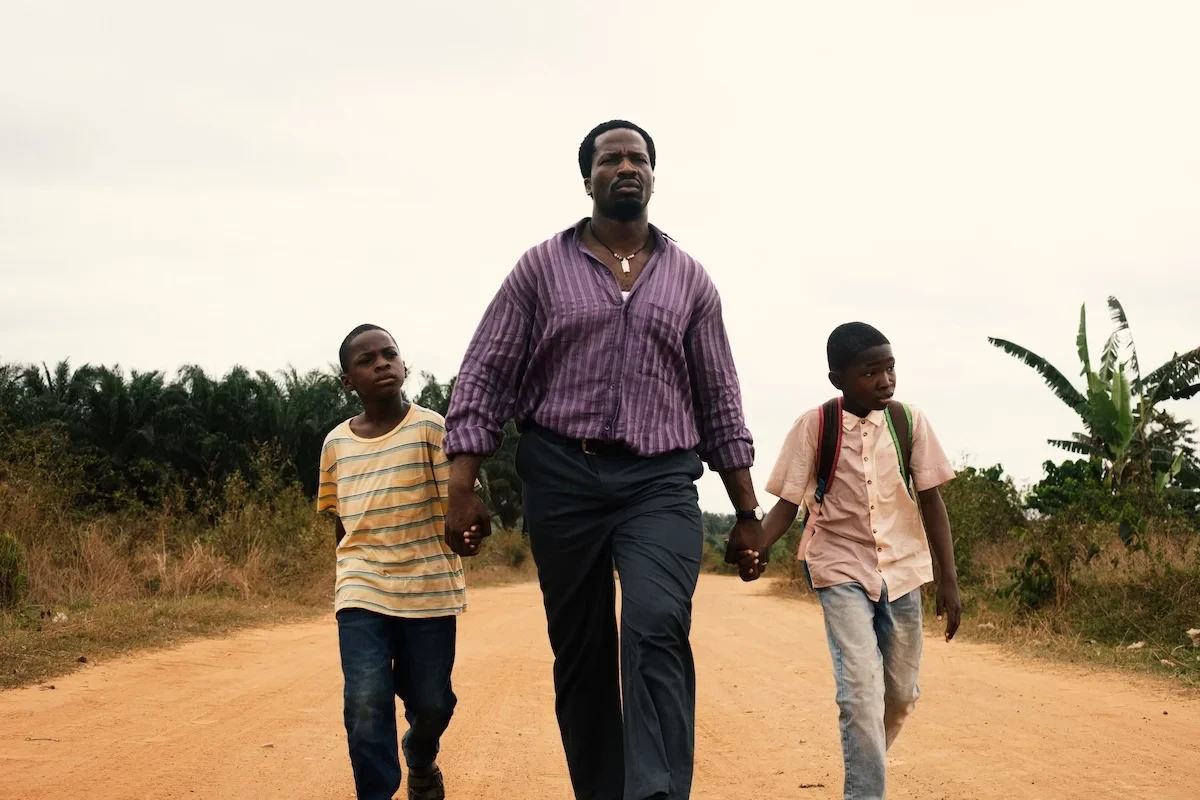
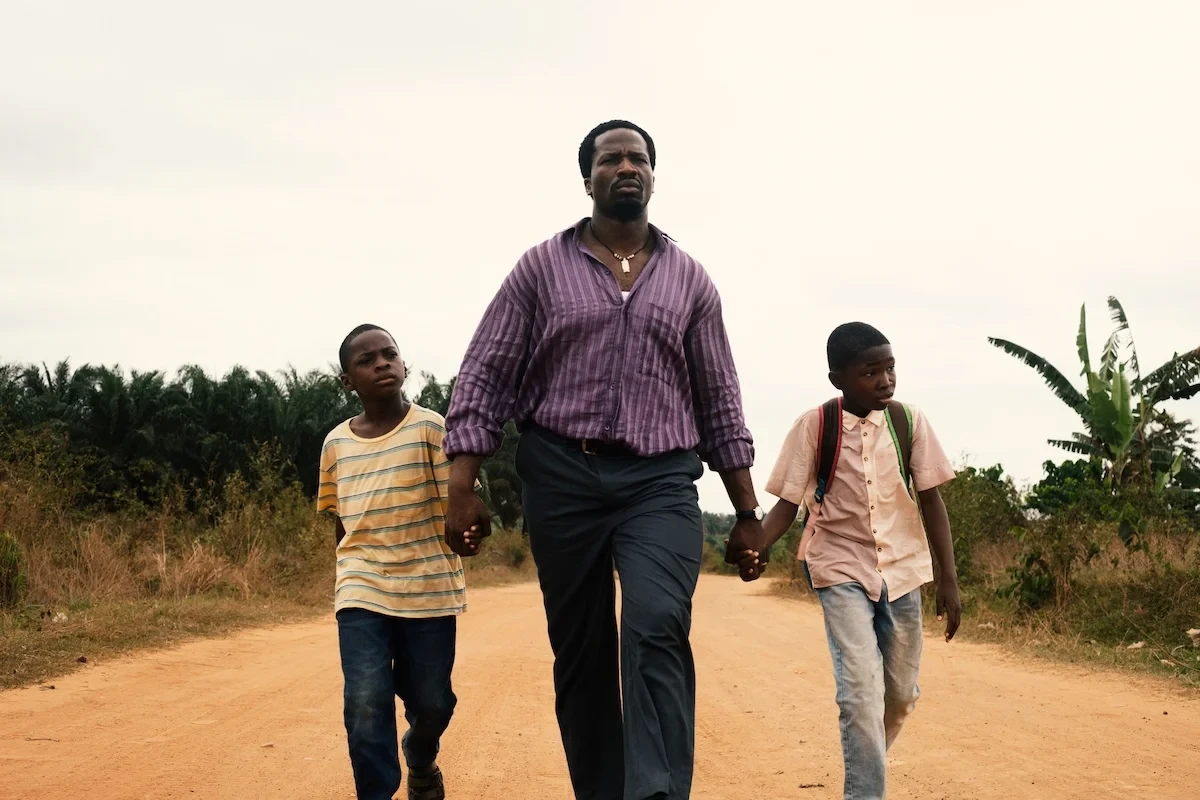
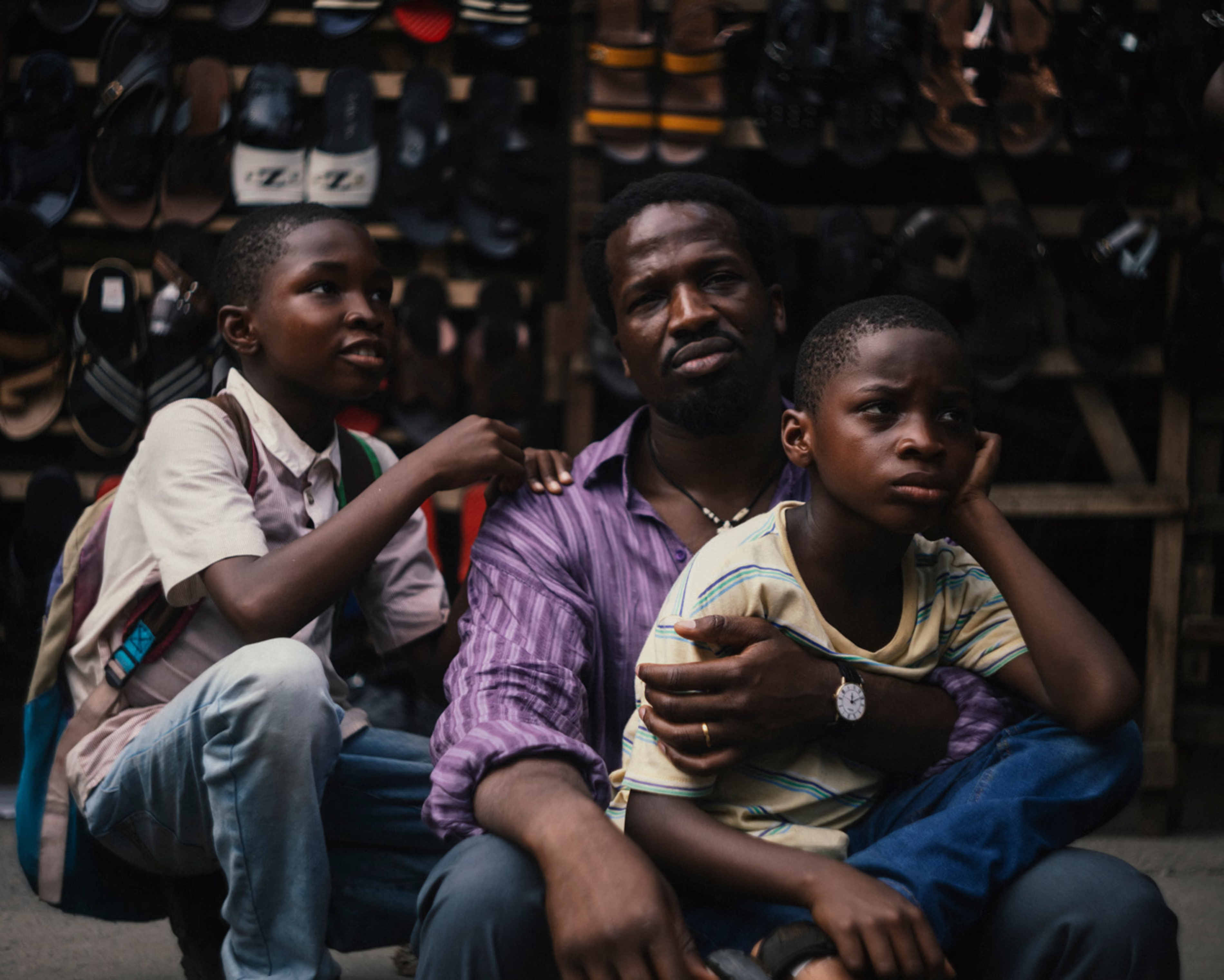
The film is larger than his earlier work, but its emotional center remains small and precise: a father, two boys, and a day that seems ordinary until it isn’t. Unfolding over the course of a single day in Lagos in 1993, the story follows the two brothers as they move through the city with their father while political tensions simmer in the background.
Davies approaches the historical moment obliquely. The film stays close to the children’s universe, attentive to fragments rather than explanations: the way a city sounds in the afternoon heat, the shifting mood of adults, and the sense that something consequential is unfolding just beyond the frame. The sound of waves accompanies floating thoughts and words, as fruit is seen decaying in the sun. However, none of this feels sad nor stressful, but simply observed and contemplated as it happens. The journey is accompanied by a gentle piano that dances across octaves braided with rich atmospheric sounds, and an untutored flute signals the arrival of new scenes.
Experiencing all of this feels as though we have exited the canonical frameworks of Western and Hollywood-oriented cinema, and entered entirely new cinematographic, emotional, and cultural geographies.
Premiering at the Cannes Film Festival, the film marked a historic moment as the first Nigerian feature selected for the festival’s official lineup. Yet the significance of Davies’s work extends beyond that milestone. His visual language quietly unsettles the narrative grammar that has long dominated global cinema: the inherited structures of Hollywood storytelling, with its clear arcs and emphatic resolutions. Davies bends those conventions, slowing them down, fragmenting them, and allowing narrative to drift toward observation and atmosphere.
In this way, his films resonate with a longer lineage of filmmakers who repositioned the camera away from Europe and North America as the gravitational center of cinematic meaning. The Senegalese director Ousmane Sembène once articulated that African cinema should not look outward for validation but inward, toward its own histories and rhythms.
Davies’ work, though shaped by a life lived between London and Lagos, moves with a similar instinct: drawing from global film language while subtly reworking it, reorienting its perspective so that the frame begins elsewhere. What emerges is not a deviation from an established grammar but another way of inhabiting it, one in which narrative, place, and memory are allowed to unfold according to their own internal logic rather than an inherited hierarchy of forms.
My Father’s Shadow is an attempt to walk back into that archive and see what still flickers there. What emerges is less a reconstruction of the past than a portrait of how memory rearranges it—softening some edges, sharpening others, and leaving certain rooms to rest in tender and partial shadows until time desires, while still knowing they exist, within a broader drawing.
A: Hello.
H: Hello, how are you?
A: I'm very good, how are you?
H: I'm good. Calling from Milan—there's sun now so it feels better, I guess.
A: I love that for you.
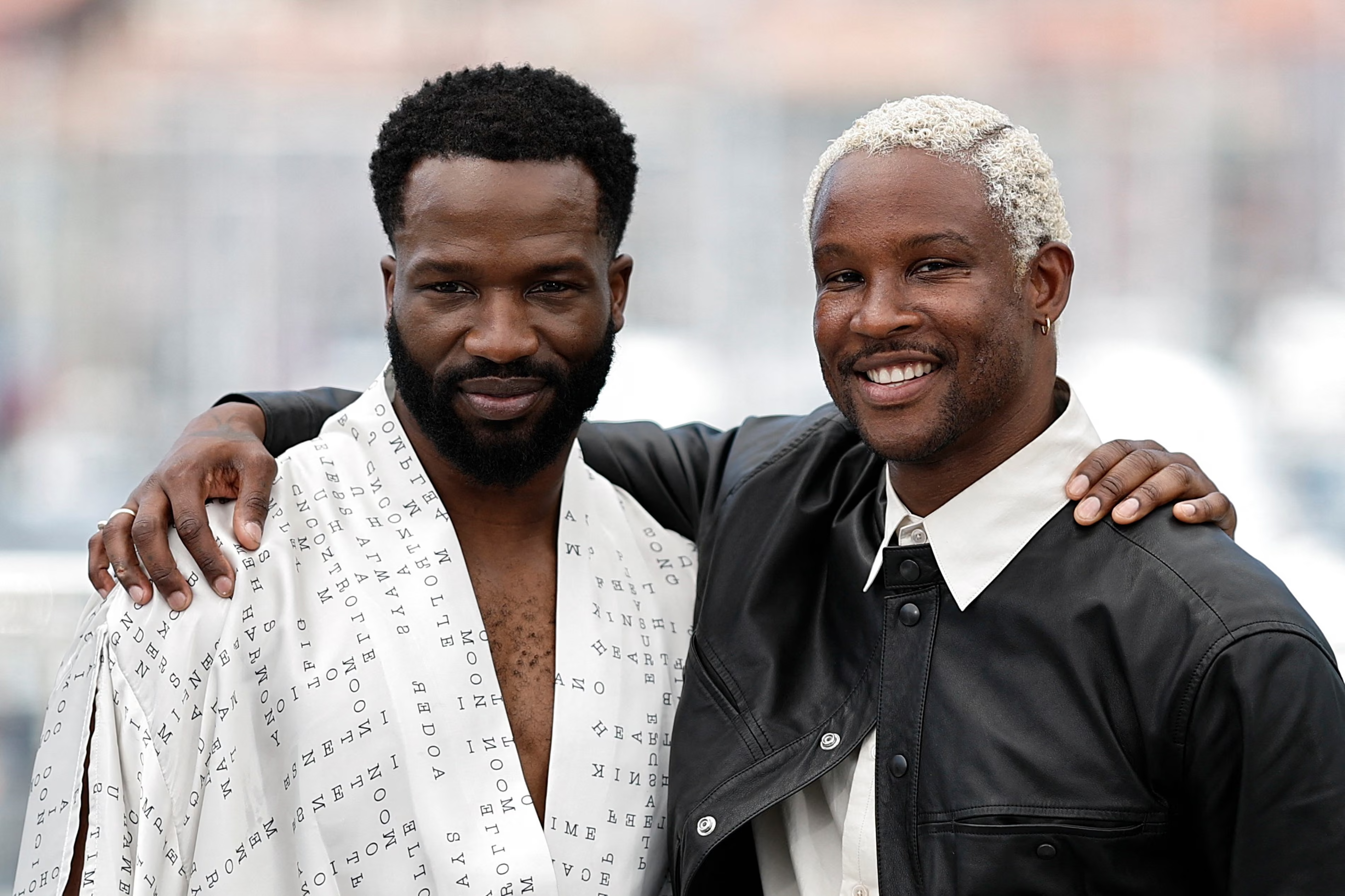
H: How are you doing at the moment? I saw there were the BAFTAs a few days ago, and Cannes with your brother and the whole crew just before that. I imagine there must be a lot of emotions involved … So how are you feeling?
A: I feel pretty good. I feel pretty chill. We had a lot of work to be getting on with, irrespective of what happened. I don’t even know what day it is now. I’m very proud of the film personally. I’m supported by some really incredible people, so I'm thankful to be around them. Our film made history the other night in many different contexts, and I'm proud to be alongside such incredible collaborators.To be here in my studio, around my partner and people I really care about.
Origins and Buds
H: I was wondering about the genesis of the film. In previous conversations you mentioned writing it with your brother. What ultimately brought it to life?
A: I think the genesis of the film was my brother. He watched an Oprah Winfrey show where there was a prompt to write a letter to a bereaved family member. He tried multiple times, and every time he wrote he broke down crying. At that point he realized there was something there to interrogate.Then he wrote the script—the first script he ever properly wrote—which was a short version of My Father’s Shadow. A few weeks later he sent it to me. I cried when I read it. I had a big emotional response because I’d never really conceived the idea of humanizing my father. After that we made a short film together called Lizard. It had a lot of success. Off the back of that, we knew making a feature would be a huge undertaking with many people involved. So we wanted to make something that reflected something for our family, for ourselves, for the country we grew up in, for children of the diaspora. But mainly it was for us—to have a conversation with our younger selves. I asked him if he’d let me revisit the script he’d written years before. That’s how it came to be.
H: How was it to work with your brother? Was it hard to write such an intimate script together?
A: My brother is someone I've idolized for a long time. He's the closest I've had to a father figure for a long period of time. He's very creative, very fair. We both have to exercise a lot of patience working together, because that doesn't always come naturally. But no, I don’t find it hard. There's a line in the film: family is the most important thing. I kind of agree. Family knows you best. They've known you for a long time. Of course not everyone has that privilege, but in our case we've always been close. Working together is an opportunity to be more vulnerable with someone you love.
The Skeleton of a Tale
H: That’s beautiful. Your work feels like an offering outside conventional Hollywood formulas. It resists linear storytelling and moves through memory-driven structures, while also challenging tropes about fatherhood, masculinity, heritage, even collective trauma. How did you distance yourself from standard cinematic expectations?
A: I would probably say we both arrived at film in very unconventional routes. Neither of us necessarily expected to become filmmakers. My brother was more interested in music and lyrics and what comes on a page. I was interested in images. But culturally, we're Yoruba, we're Nigerians. The stories we were told growing up, and the way they were told were never linear. They didn’t follow a three-act structure. They didn’t separate the animal world from the spiritual or mythological worlds. I remember a children’s show every Sunday in Nigeria called Tales by Moonlight—folk stories where animals spoke to humans. To us that just felt like those were just our stories. Equally, being Black and African often means your stories have been erased through colonisation. So you have to become the authors of your own stories. You have to tell them again and again. You tell them orally. When we make films we ask: how much of our culture, our spirituality, our mythology can we put into the structure? We want our stories to feel like they belong to something bigger, and dynamic, cause literally just is in constant movement,
H: How was the process of creating the characters, for instance?
A: A lot of the stories came from what we’d heard growing up. We lost our father when we were very young, so whenever I said my name in Lagos, people who knew him would respond with this overwhelming response, which I never fully understood. We were always getting stories about him—and same for Wale. That became a source for building characters. I wouldn’t say it was easy, but we knew where to draw from, and the rest came from ourselves and from people we knew in the world. When my brother and I write, we start with a character bible:
Who are our main characters?
What are their personalities?
What are they like as humans?
What’s ironic about them?
What are their hang-ups?
What are the good things?
What are the bad things about them?
Many of our character profiles are based on real people and their experiences. That helps the story feel richer, fuller, and more 360, rather than one-dimensional. We’re always conscious of making characters feel real, not caricatures, because at the end we are telling stories of real people.
Contemporary Celluloid
H: I echo that. It transpires a lot in the film – the way even the smallest details are given attention. Even though I come from a different diasporic background, I felt very close to the details you showed. They are incredibly tactile through the film, and they place the audience in a position of feeling the film rather than just viewing it passively. I was also struck by the decision to shoot on film, because it gives the story such a particular depth and texture. Did you face any challenges convincing collaborators or producers?
A: I always say to my filmmaker friends: if you don’t advocate shooting on film with your own money, you’ll never shoot on film with other people’s money. Film isn’t actually that complicated—it’s been happening for over a hundred years. I think the barrier people talk about is resources. But as a Black filmmaker I’ve always worked with limited resources anyway. And when resources are limited you have to be very specific about what you shoot. You plan your shots. You know why you're taking them. You know where the camera will be and how many takes you'll allow yourself. Working on film forces that discipline. I like the pace of it. It's respectful to the people you're working with. It gives everyone time to focus on their craft. Digital can sometimes create a speed that feels almost machine-like. With celluloid, once you run out, you run out. That’s a wrap. I prefer that way of working. And it kind of echoes also what you were saying about character development, it adds that extra layer of texture I’ve said the political side of shooting on film is important. Nigeria deserves it, and people of color deserve to see their cities, families, and culture captured in the most beautiful format. Film allows these stories to be treated with reverence—you think about the light, the composition, the positioning of the camera. Everything gains aesthetic care and depth, making the work visually seductive in a way our cultures deserve. Growing up, African cultures were often othered. People imagine us running with zebras and lions, but our histories predate colonialism. They are rich, textured, and foundational - introducing alphabets, astronomy, astrology, and more.There’s a responsibility in taking authorship of these cultures, presenting them in a way that asserts respect, honors their depth, and resists simplification.
Choral
H: 100% agreed. I sensed that the film feels very choral; every technical role feels central to the work, from sound, to costumes and castings and so on. It rejects the typical verticality and hierarchy of a Hollywood set. How did you go about building that kind of team?
A: I’ve been working in Nigeria with my brother for ten years. That time allowed us to build relationships and find the right collaborators. I love the crew because I used to be part of a crew. I assisted in costume, in production design, even making tea. So I know how important those roles are. I don’t like sets with hierarchy. I refuse the idea of a director as a godlike auteur. None of that exists without collaborators, especially the technicians who rarely get celebrated. When building a team I prefer working with good humans over brilliant artists. Hollywood often celebrates directors and stars, but many of the real artists are the technicians—the people who rarely get acknowledged. I’ve spent ten years working with people in Nigeria and the UK, trusting producers and other team members’ recommendations and building relationships. I prefer working with good humans over just skilled artists. Nine times out of ten, I’ll choose the better human.
“The Personal is not Political, the Political is Personal” (A. Sivanandan)
H: Coming from a diasporic background, I was moved by how the film approaches politics—with questions rather than answers. Could you speak about how politics informs your work?
A: I grew up under military dictatorship, so my formative years were inherently political. My grandfather was a trade unionist who worked with youth during Nigeria’s independence movement. My mother raised four children as a single parent. So politics was always present. But I’m also aware of how conflict is simplified. Many divisions—tribal, ethnic—are colonial tools used to separate people. In reality our cultures are deeply interwoven. When we made the film, my brother and I kept asking: how do we give context to complicated issues? You can love a country and still live under dictatorship. Both things can be true at the same time. Simplifying those tensions removes the humanity of the people living through them.
H: Exactly. It's about observing without reducing reality to a binary of good and bad. To build on our earlier discussion about non-Western perspectives on moral dualities, it is actually an act of love to look at your home with a critical eye without banalizing its context. By navigating those contradictions, the film invites the viewer to engage actively with the story and inhabit its complexities rather than simply witness them.
Spectators
H: So my next question is, who did you imagine this film for?
A: If I had to choose, it’s for many. I’d say anyone who’s had a father. That’s already a very broad community [laughs]. Then maybe anyone who has lived under authoritarianism. Anyone who has siblings. Anyone who loves their home but has a complicated relationship with it. If I had to narrow it further, I’d say Africans, or people in the Global South. But I also hope audiences engage with the film actively. I prefer films that encourage curiosity and questions. Passive viewing isn’t very interesting to me. Art should open dialogue.
Sounds of a day in Lagos
H: I was fascinated by the soundscape and score. I felt like it gave the viewer an idea of the actual space the characters were navigating: the chaos of the city, the crowdedness of the buildings, and that feeling of wetness given by the land, as Lagos is built over mangroves. How did the process of music-making work?
A: Before directing I assisted on music documentaries. Then I started DJing and became more interested in sound. On Lizard I met an incredible sound designer I’ve worked with ever since. Sound design is one of the most underrated parts of filmmaking. For the score we worked with Duval Timothy and CJ Mirra.
We talked about themes like decay of things, the dynamicity of childhood, and repetition quests and memory. Duval recorded sounds on set—the natural atmosphere of the spaces we were filming. During the process he also had a child, so you can actually hear his daughter crying in some parts of the sound design.
For me it's about texture. When you're making a film about memory, sound and smell can trigger emotions instantly. Street vendors calling out, ambient noise, instruments slightly out of tune, those things evoke a place.
That’s what we tried to capture.
***
As a matter of fact, the resulting music is a brilliant fusion of both artists' techniques, bridging Duval’s stripped-down style with Mirra’s dense, multi-layered arrangements. To craft this immersive wall of sound, they pushed the boundaries of audio manipulation until the actual instruments became impossible to identify. As they revealed in interviews regarding their process, they took studio-recorded melodies, blasted them outdoors, and taped them again in the open air to absorb the environment. They also had people play the flute with an intentional lack of skill to capture the raw energy of a child trying an instrument for the first time.
These clips were then recorded onto an old-school four-track cassette machine and spun at the wrong tempo to forge a completely original, surreal sound. Even the piercing whistle in the track "Journey Begins" was created by taking Duval's voice and stretching it into something unrecognizable—an effect so unique they resorted to squeaking a dog toy to recreate the sound on stage.
Ultimately, this collision of distorted sounds reflects how artificial memories operate, slowly dissolving the more you try to focus on them. You can hear this effect perfectly during the beach scene where father and son, Folarin (Ṣọpẹ́ Dìrísù) and Remi (Chibuike Marvellous Egbo), intimately converse, as their words share the same space as the crashing ocean waves and the background audio of Duval's child splashing in the tub.
***
H: Last question. I’d like to end the conversation with suggestions and recommendations that feel meaningful to you. Any filmmakers or musicians who inspired you recently?
A: So many. I listen a lot to the album Promises by Floating Points and Pharoah Sanders. Almost every week. In cinema, Hirokazu Kore-eda is one of my favourites—Shoplifters especially. And Mandabi by Ousmane Sembène was a big influence on My Father’s Shadow.