
The Forgotten Story of the Soviet Negro Republic

For decades, the idea of a Soviet-backed Black state in the American South has been dismissed as little more than Cold War conspiracy. Yet behind the propaganda lies a far more complex history, one that reveals how communists, Black radicals, and anti-colonial struggles grappled with questions of race, class, and self-determination in the twentieth century. In this article, Mattia Marzà retraces the history of the so-called "Soviet Negro Republic", exploring the debates within the Communist Party USA, the Comintern, and the Civil Rights movement. The result is a fascinating story about the tensions between anti-racism, internationalism, and revolutionary politics, and about how political myths are often built upon fragments of historical truth.
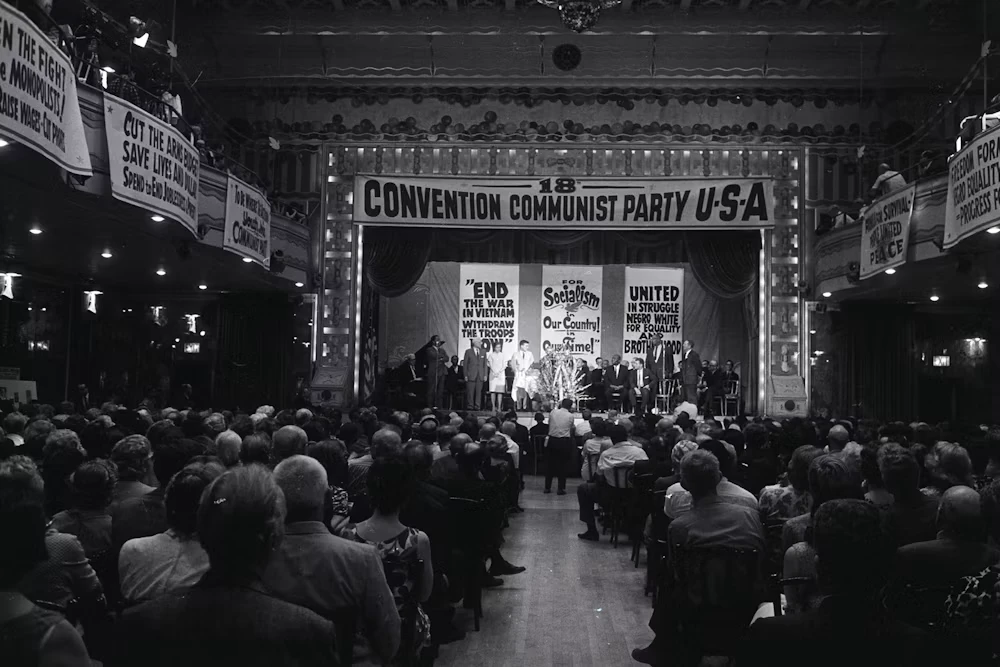
“What’s wrong with civil rights?”, rhetorically asked the author of a pamphlet of the same title, published in January 1965 on American Opinion, a magazine linked to the right-wing advocacy group John Birch Society. It’s easy to come up with an answer: in and of itself, nothing. The matter is rather «what is being done [...] in the name of civil rights»; namely, what communists do in the name of civil rights.
Lyndon Johnson had just taken office as President following his successful electoral campaign in 1964; roughly four months after the Maddox incident, the US army was about to engage in the Vietnam War; almost a year had passed since the Beatles’ triumphant first tour across the Atlantic, and the band was smoothing out their next album, Help!, due for release in August 1965; though, reading this anonymous piece, one might feel as if they had been suddenly catapulted straight in the McCarthy era, when the so-called “Red Scare” generated a collective psychosis, led to thousands of arbitrary arrests and show trials, and marked the start of a full-fledged season of terror against communists – real and alleged. Although the term “Evil Empire,” coined by Ronald Reagan in 1982 to describe the Soviet Union, had not yet entered public discourse, it is nonetheless the best way to describe the portrayal of communists in this text: they plot in the shadows to foment a civil war, and try to exploit unaware African-Americans (who, on their behalf, have nothing to complain about, since their life conditions are «far superior to that of ninety percent of the earth’s population») for the benefit of their «self-perpetuating clique of international gangsters».
The final goal of this red conspiracy is to establish a Black soviet republic in the south-eastern United States, a plan conceived by Stalin himself. The publication’s overt racism makes it quite hard to read, and its furious anti-communism is both shocking and tragicomic: yet, the idea of a secessionist Soviet state for African Americans is not entirely an invention of far-right propaganda.
The two political parties that merged into the Communist Party USA in 1921 - the Communist Party of America and the Communist Labor Party - never specifically addressed the issue of African-American conditions, instead interpreting racial oppression simply as a form of capitalist exploitation, or not mentioning it at all; and initially the CPUSA stuck to the same approach. The debate over racism and Black nationalism in 1920s America was particularly vivid, driven by the momentum of the Harlem Renaissance and the valuable political and intellectual work of organisations such as the African Blood Brotherhood or the Universal Negro Improvement Association and African Communities League, both founded by African-Caribbean activists, respectively Cyril Briggs (also the founder of the small, yet influential, magazine The Crusader) and Marcus Garvey. A delegation from the African Blood Brotherhood attended the founding convention of the Workers Party (the legal party organisation of the CPUSA) in 1921 and there were also several other exchanges and contacts between militants from the two organisations.
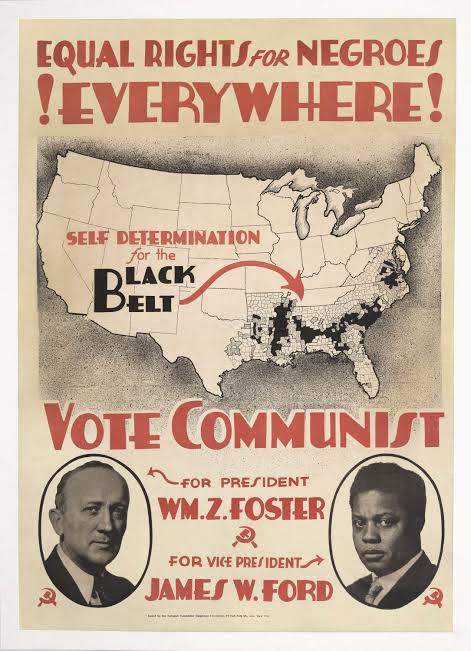
Meanwhile, several African American militants flew to Moscow and Europe to attend Comintern meetings and political schools, debating with their European counterparts about the political and social situation of Black Americans, and the possible revolutionary developments. However, a programmatic link between Bolshevism and Black nationalism did not emerge until the end of the decade. That shift formed part of the broader transformations taking place in the Soviet Union and, consequently, in all the communist parties worldwide. At the Sixth Congress of the Comintern in 1928, the so-called “Third Period” theory was adopted, which described social democracy as the real enemy of the communist movement. From that Congress until the Nazis came to power in Germany in 1933, communist attacks and propaganda primarily targeted the “social fascism” and, more broadly, the reformist tendencies within leftist and workers’ movements. The driving force of the October revolution had faded in the West, making a revolution in Europe seem very unlikely: thus, the Comintern’s focus shifted more and more to anti-colonial and national liberation movements all across the world. It was in this spirit that African Americans were declared a “subject nation” – i.e. an ethnically, linguistically and culturally homogeneous group of people oppressed by an imperialistic power: for this reason, according to Soviet views on nationality and sovereign territorial power, this group needed a state of their own, which was identified with the “Black Belt” of the United States.
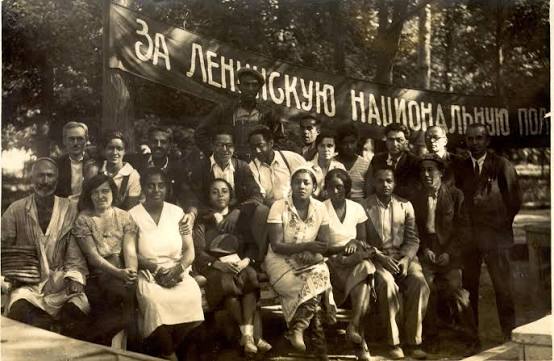
This resolution stated that African Americans were capable of giving rise to a national revolutionary movement, and that this issue was of the utmost importance. This claim was not entirely unprecedented: as early as the second Congress (1920), Lenin had suggested including African-American political structures among the anti-colonial and national liberation movements. Before the sixth congress, the Comintern had not followed that indication, focusing solely on African and Asian contexts in their anti-colonial perspective. But now, every Communist party was strongly recommended to support their struggle to develop national and class consciousness, organise a collective movement and, ultimately, gain autonomy and independence: for the first time since the Civil War, the African-American issue was recognised as a matter of international relevance.
The CPUSA had somehow anticipated this shift: in May 1928, in fact, it had established an entire section devoted to fighting the “Oppression of the Negroes”, proclaiming itself the champion of not only the working class, but also of the “oppressed races”. However, the party now had to resolve its internal disputes and take on the African American issue more seriously than before: above all, the request from Moscow, and from the notable contingent of African American militants living there, was to eradicate racism within its ranks once and for all. In fact, Black American communists weren’t fond of the party’s attitude towards them: there were several militants who lamented internal racism against them, such as James Ford, who declared in 1928 that the party was “underestimating” their work and denounced that Black activists were “persecuted and driven out of the party”, or Otto Hall, who attacked the white chauvinism within the party. It wasn’t uncommon that such criticism and grievances were carried directly to Moscow: this practice simultaneously brought attention to the African American issue, and to the racist attitude of the white militants within the CPUSA, and reduced the issue to one of many internal debates, within the framework of the readjustments of each national communist party after the political shift of the sixth Comintern congress. Even when directly addressed, racism remained an abstract issue, not a crucial point of discussion: the debate was a polemical tool for internal games of power, rather than a political horizon to move towards.
However, this new centrality attributed to African American self-determination was not welcomed as warmly as one might imagine. In fact, only one of the African American delegates to the Congress, Harry Haywood, supported this new concept, despite being initially against it as well. Even later, when the subcommittee on African American affairs was enlarged and placed directly under the Colonial Commission, most Black CPUSA militants strongly criticised the proposal to establish a separate state for Black Americans: partly for strategic issues – like Otto Hall, who highlighted the fact that most African Americans effectively saw themselves as Americans, and therefore wouldn’t be particularly willing to support a secessionist state – and partly for political matters – this proposal, they stated, would have further widened the distance among Black and white workers. Also, it was hard to interpret the US context as identical to that of African and Asian countries under colonial domination, or the African American condition in urban ghettos and southern fields as equivalent to that of Filipinos, to mention one of the US’s colonies: many militants felt the urge to synthesise a more accurate position, taking into account the specificities of the North American scenario.
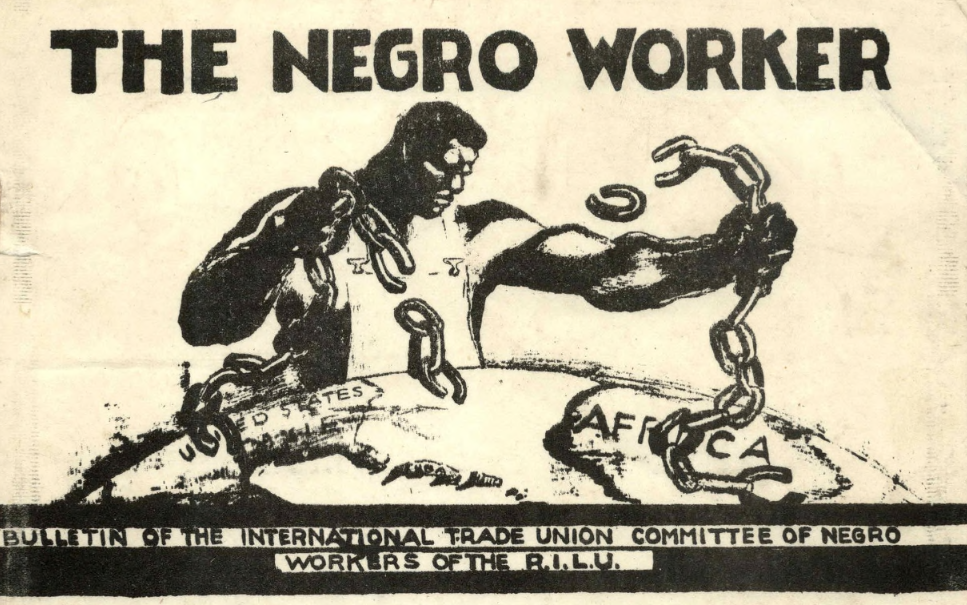
Above all, almost all Black militants and several white ones pointed out a crucial notion: it wasn’t the lack of program or ideology to hinder communist organising among African Americans, but rather the racism and chauvinism internal to the party. Black liberation didn’t require elaborate blueprints for a future Soviet republic but a grassroots and unionist work that could simultaneously improve African Americans’ present conditions and recompose the unity and harmony of the working class, both Black and white, against capitalism and racism.
Nevertheless, the party began to carry out the new directives and to give more centrality to African Americans. CPUSA's attempts faced strong opposition from its members, particularly from migrant communities such as the Italian and European Jewish communities. However, African Americans were effectively more involved in the party's political life and mobilisations, particularly in demonstrations against unemployment and anti-eviction pickets.
The idea of a separate state for Black Americans was also exposed in the 1935 short essay The Negroes in a Soviet America by James Allen and James Ford. The pamphlet insisted on the continuity of exploitation both before and after the abolition of slavery: the “plantation country” hadn’t finished with the end of the Confederation, and in fact it was as wide and brutal as it had been. Slavery had been abolished only in legal terms. The American ruling class uses severe measures of oppression in order to keep African Americans in the rural South and, when that is no longer possible, adopts the same measures to prevent them from gaining decent jobs and wages in industry. They also fuel racism through the Jim Crow laws in order to create an unbridgeable gap between Black and white workers. The authors strongly criticised the NAACP, deeming its methods “treacherous” and its reformism ultimately complicit in racial and capitalistic exploitation: African Americans have to face “two revolutions in one”, and cannot restrict their outlook to democratic claims to equal rights within the common exploitation of the capitalistic system.
Thus, Allen and Ford defined self-determination and the proletarian revolution as two distinct, yet inseparable, goals for African Americans. Whether the revolution triumphs first in the predominantly Black rural South or the mostly white industrial North, the outcome will be the same: complete national independence for Black Americans within a new, Soviet-like America. The pamphlet is also interesting because it contains an illustrative conversation with a hypothetical racist white worker, almost a how-to guide for successfully converting (still) unaware allies: even when prospecting a secession, the communists’ goal is to reunite the working class. However, Black self-determination wouldn’t imply a segregated state, and white people wouldn’t necessarily need to move away: simply put, as the inhabitants of the Black Belt are mostly Black, the Soviet state and government that would be constituted in that territory would be shaped accordingly.
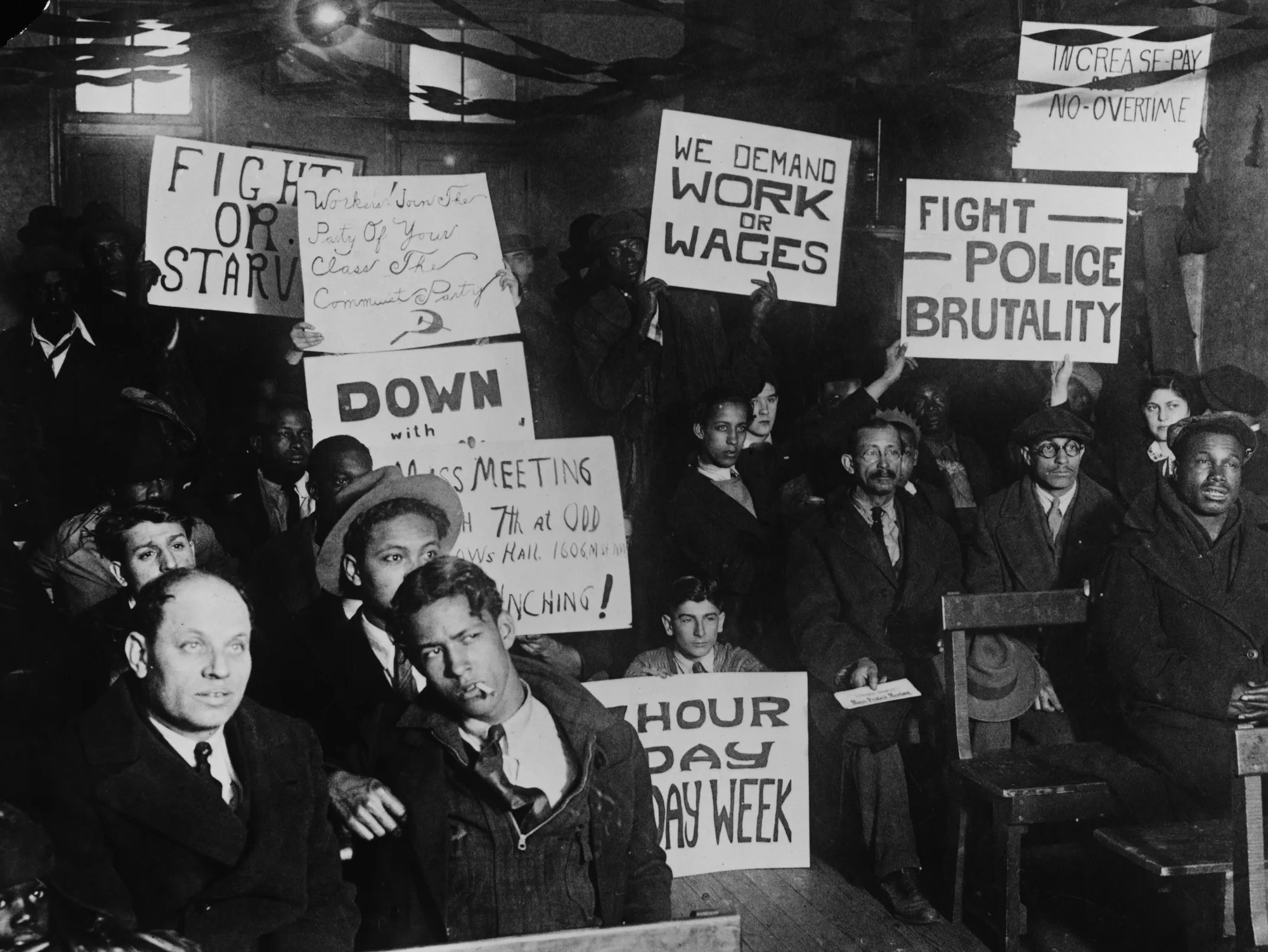
One of the authors, Allen, played a pivotal role in the CPUSA’s engagement in support of the Scottsboro Boys, nine African American teenagers accused of raping a white woman in 1931: the party provided legal assistance during their show trial – which resulted in five sentences of up to 99 years in jail -, generated media coverage and organized worldwide solidarity and publicity campaigns on their behalf. The campaign for the Scottsboro case was one of the most important that the CPUSA had ever undertaken, and provided an opportunity for the party to work alongside African American churches, newspapers and organisations, such as the NAACP. However, the idea of a secessionist state for Black Americans was already losing importance within the party’s theory and discourse.
The idea re-entered public debate during McCarthyism, when dozens of former communist militants cooperated with the U.S. House Committee on Un-American Activities, denouncing what they claimed was a secret communist plot to establish a Black Soviet state. One of the most important informants was Manning Johnson, an African American who had left the party in 1939: he identified several alleged communist activists (most of whom were later acquitted) and “revealed” the plot behind communist support for the Civil Rights movement. During the 1950s, Johnson repeatedly criticised the NAACP for fuelling and “exacerbating” the struggle for integration for their own benefit and for acting as useful fools of communists.
Needless to say, the idea of a secret plot involving Moscow, the CPUSA and Civil Rights organisations existed only in far-right propaganda: the idea of a secessionist state for African Americans never gained full endorsement of the Communist Party, let alone that of organisations with very different ideologies, such as the NAACP. The “Soviet Negro Republic” was one of several proposals for how to structure and direct the Communist Party’s work in the United States: it had to face the deep racism among the party’s ranks, but it was also supported (or opposed) by the genuine, yet often too weak, antiracist component of communist movement. The proposal was perfectly coherent with the internal debate of the Third International, and it reflected its strengths, its weaknesses, its idiosyncrasies; moreover, when discussing it, communist militants all across the world were not divided (not only) along colour lines, but by virtue of different opinions within a common political and strategic framework.
When viewed through the lens of today, several factors intertwined in the history of the proposal: the obstacles that antiracist struggle had to face both within US society and CPUSA; the quest for a political theory that could unite workers regardless of race; the Comintern’s sometimes simplistic approach on the matter of segregation and national self-determination. Especially, when considering the far right propaganda on the matter, which sinisterly resembles the conspiracy theories that crowd the current political discourse, this history reminds us how, sometimes, most dangerous lies are wrapped with a small veil of distorted truth.
Bibliography
Allen, James S. and Ford, James W. (1935), The Negroes in a Soviet America, Workers Library Publishers.
Berland, Oscar (1999), The Emergence of the Communist Perspective on the “Negro Question” in America: 1919-1931: Part One, Science & Society, Vol. 63, n. 4, pp. 411-432.
Berland, Oscar (2000), The Emergence of the Communist Perspective on the “Negro Question” in America: 1919-1931: Part Two, Science & Society, Vol. 64, n. 2, pp. 194-217.
John Birch Society (1965), What’s Wrong With Civil Rights?, American Opinion.