


Selling the Struggle. The Exploitation of Black Culture and Radical Practices by Western Capitalism

From protest aesthetics to radical language, Black struggle has repeatedly been absorbed, sanitized, and sold by Western capitalism. What happens when resistance becomes a commodity, and who ultimately profits from it?
Although self-care was originally rooted in non-material practices aimed at protecting individuals and communities, contemporary understandings have shifted in the opposite direction: it is now largely understood through the lens of consumption, products and routines. In Western capitalist societies, taking care of both the mind and the body has become a moral imperative as well as a marketable product, sold through accessible, quick and simplified solutions. Wellness is presented as universally attainable, detached from social conditions and increasingly framed as an individual responsibility.
This framing, however, obscures the political and radical origins of self-care, which were deeply rooted in concrete and material needs. Long before it was absorbed by the wellness industry, self-care emerged within Black communities in the United States as a necessary response to systemic violence, medical neglect and institutional exclusion; as well as the political activism that accompanied these conditions. It was not about self-indulgence, but about safeguarding collective survival. In contexts where access to healthcare, safety and state protection was routinely denied, caring for oneself and for one’s community became a radical act.
Black activists and organizations reframed care as a form of resistance, linking physical and psychological well-being to political struggle. As later articulated by figures such as Angela Davis, self-care was understood as collective, intentional and inseparable from the pursuit of liberation. Yet this radical practice has since been appropriated, depoliticized and commodified by Western capitalism, which has stripped it of its historical roots and transformed it into a profitable, individualized trend.
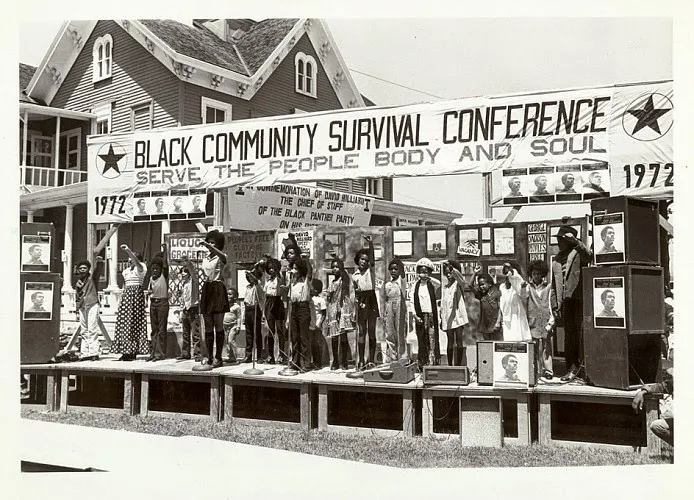
Self-care’s radical origins lie in conditions of systemic exclusion that made everyday survival precarious and isolating: racial segregation, institutional violence, economic exploitation, and, crucially, the denial of adequate healthcare. Throughout the twentieth century, Black Americans were routinely excluded from hospitals, subjected to inferior treatment, or used as objects of medical experimentation. During the Jim Crow era, segregated and underfunded medical facilities produced stark disparities in life expectancy, infant mortality and chronic illness. Even after the passage of civil rights legislation in the mid-1960s, access to healthcare remained uneven, as hospitals resisted integration and structural inequalities persisted.
In this context, care was not an abstract or therapeutic concept, but a concrete response to abandonment and the exploitation of bodies. Black communities developed informal networks of support, shared medical knowledge and collective strategies to address needs that state institutions systematically failed to meet. Self-care was never individualistic: it was relational, collective and deeply political, grounded in the recognition that Black lives were consistently exposed to harm by design.
This understanding was explicitly articulated by the Black Panther Party, founded in Oakland, California, in 1966. While the Party is often remembered for its militant imagery and confrontations with law enforcement, its political vision extended far beyond armed resistance. The Panthers understood state violence as multifaceted: not only enacted through policing and incarceration, but also through hunger, illness, environmental neglect and overall institutional abandonment. Their response was the creation of “survival programs,” initiatives designed to meet immediate material needs while simultaneously exposing the failures of the state.
The Party’s 1966 Ten-Point Program made this connection explicit, demanding not only an end to police brutality but also full employment, decent housing, education and an end to the economic exploitation of Black communities. Care was embedded within a broader critique of racial capitalism. Liberation, the Panthers insisted, could not be separated from the material conditions that sustain life, nor from community control over the infrastructures that shape well-being.
Healthcare became a central terrain of struggle. Beginning in the late 1960s, the Panthers established free medical clinics in neighborhoods where access to care was limited or openly hostile. By the early 1970s, many local chapters were expected to operate a clinic as part of their political work. These clinics provided basic medical services, preventive screenings and health education, including testing and awareness campaigns for sickle-cell anemia, a disease long ignored by mainstream medical institutions despite its disproportionate impact on Black Americans. These initiatives were not framed as charity but as acts of self-determination that challenged who held authority over Black bodies.
Crucially, the Panthers’ approach to care rejected individualism. Self-care was not understood as withdrawal from political struggle but as a means of sustaining it. Physical and psychological health were treated as collective responsibilities, inseparable from resistance. Activists recognized that exhaustion, trauma and illness were not personal failures, but predictable outcomes of living under conditions of racialized violence and economic exploitation.
This perspective was echoed and expanded by Black feminists and political prisoners associated with radical movements of the late twentieth century. Angela Davis, during her incarceration in the early 1970s, turned to practices such as yoga, meditation and controlled breathing, not as forms of spiritual escape but as tools of political survival. These practices helped preserve mental clarity, bodily autonomy and emotional resilience under conditions explicitly designed to break them. Caring for oneself, in this framework, was an act of resistance against systems that relied on exhaustion, fear and psychological erosion to maintain control.
Embedded within these practices was a clear rejection of capitalist logic: radical self-care functioned outside the realm of consumption, it required no commodities, no optimization and no market mediation. Its value lay in solidarity, endurance and shared responsibility, qualities fundamentally incompatible with a system that transforms care into a product and survival into a personal achievement.

The meaning of self-care began to shift in the decades that followed. From the late 1970s onward, the rise of neoliberal ideology reframed social problems as matters of individual responsibility, while collective infrastructures were systematically dismantled. In this political landscape, the language of care was detached from its historical and racial context and absorbed into market-friendly frameworks. What had once emerged as a response to structural violence was repackaged as a set of personal strategies for managing stress, maintaining productivity and adapting to precarity.
This process of appropriation is neither accidental nor neutral: white Western capitalism has historically positioned Black cultural production as a resource, something to be mined, aestheticized and detached from its material conditions. Practices born out of oppression are rendered “universal,” their racial and political specificity erased to make them palatable, marketable and safe. In doing so, the system both profits from Black creativity and distances itself from the violence that made those practices necessary. Self-care becomes acceptable once stripped of its confrontational edge, once it no longer names racism, exploitation or state neglect but instead promises individual relief without collective disruption.
The contemporary wellness industry plays a decisive role in this transformation. By the 1990s and 2000s, self-care had become synonymous with consumption: products, routines and services promised relief from burnout and anxiety, without addressing the conditions that produce them. Structural injustice disappeared from the narrative, replaced by self-optimization and personal resilience. Care was aestheticized, individualized and made compatible with a system that demands continuous performance. The question at the heart of care shifted from “how do we overcome and survive this oppressive system?” to “how can you function better within the economy that exhausts you?”.
In this shift, self-care lost its oppositional force. Rather than challenging systems of exploitation, it increasingly functions as a mechanism of accommodation, encouraging individuals to cope with injustice rather than confront it. The transformation of self-care from a collective, non-material practice into a profitable industry is emblematic of how Western capitalism absorbs and neutralizes radical alternatives, particularly those produced by Black communities.
The contemporary language of self-care largely benefits those already shielded from the most violent effects of structural inequality. Framed as a universal solution, it obscures the fact that the ability to rest, retreat or invest in wellness is deeply shaped by race, class and material conditions. What is marketed as empowerment often reinforces individualism, shifting responsibility away from systems and onto those forced to endure them.
Reclaiming self-care means restoring its political content, it requires reconnecting it to the structures that make it necessary in the first place and refusing the idea that well-being can be achieved through consumption alone. When understood as a collective and anti-capitalist practice, self-care regains its original purpose: not self-optimization, but solidarity; not retreat, but resistance.
Sources
Newton Huey, P. (1980). War Against the Panthers. PhD dissertation, UC Santa Cruz
Talbot, H. (2022, Oct. 27). The Black Panther Party and the Radical History of Self-Care. The Bristorian. Online: https://www.thebristorian.co.uk/blackhistorymonth/blackpantherpartyandselfcare?
Aparicio, I. (2025, Mar. 3). Rooted in care: The Black community’s legacy of self-care and empowerment. The Vindicator. Online: https://www.thevindi.com/post/rooted-in-care-the-black-community-s-legacy-of-self-care-and-empowerment
1. Angela Davis, Freedom Is a Constant Struggle: Ferguson, Palestine, and the Foundations of a Movement (Chicago: Haymarket Books, 2016). Davis frames self-care and collective care as necessary political practices for sustaining liberation movements, rejecting individualistic interpretations of care
Audre Lorde, A Burst of Light and Other Essays (Ithaca, NY: Firebrand Books, 1988). Lorde famously defines self-care as an act of self-preservation and political warfare, a concept later taken up and rearticulated by activists and scholars such as Angela Davis within collective liberation struggles
2. Henrietta Lacks (1951): cancer cells were taken from Lacks without her knowledge or consent and used to create the HeLa cell line, one of the most important tools in modern medical research. See Rebecca Skloot, The Immortal Life of Henrietta Lacks (New York: Crown Publishing, 2010).
Harriet A. Washington, Medical Apartheid: The Dark History of Medical Experimentation on Black Americans from Colonial Times to the Present (New York: Doubleday, 2006). This work documents systematic medical experimentation on Black Americans throughout the twentieth century, including non-consensual studies, surgical experimentation, and abuse within public health programs.
3. Alondra Nelson, Body and Soul: The Black Panther Party and the Fight Against Medical Discrimination (Minneapolis: University of Minnesota Press, 2011). Nelson analyzes the Panthers’ health clinics and survival programs as a critique of racial capitalism and state abandonment, emphasizing care as a form of political resistance. The Black Panther Party Platform and Program (Ten-Point Program) (1966). The Panthers explicitly link liberation to material conditions such as housing, healthcare, food, and education, framing survival as inseparable from political struggle and community control.