
Like a White Man. A conversation with Oliwia Bosomtwe on Black Poles and Unacknowledged Minorities
How do you tell the story of a community that has long been rendered invisible? Reflecting on Oliwia Bosomtwe’s book "Like a White Man: The Story of Poles and Others", author Christian Kobluk explores the experiences and identities of Black Poles, a community shaped by shared histories of racism, alienation, and belonging. Through a personal reflection on Blackness, Polishness, and Afropean identity, he considers the importance of reclaiming overlooked histories and creating a sense of community for generations to come. At its heart, Bosomtwe’s work offers something long missing: a space in which Black Poles can see themselves, recognise their histories, and feel at home.
How to tell the story of an unacknowledged minority? How to find your space within a language that never once recognized you? How – borrowing from Jimmy Baldwin – “to communicate to the vast, heedless, cruel, white majority that you’re here”?
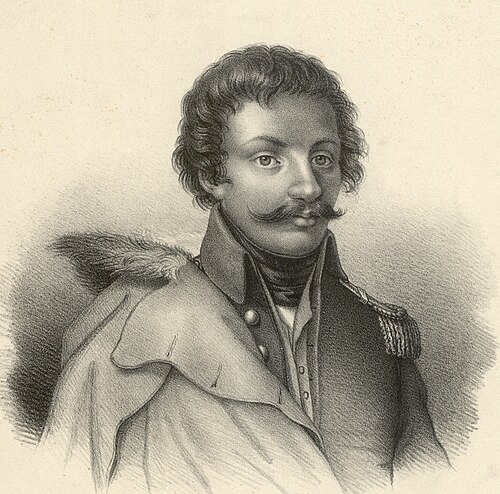
Oliwia Bosomtwe had to answer those questions, while writing Jak biały człowiek. Opowieść o Polakach i innych (Like a White Man: The Story of Poles and Others)[1]. As a journalist – and, more importantly, Black Polish woman – she knows that we’re woven by stories we’ve been telling about ourselves. She admits it at the very beginning: “I was born in a country where we like nothing better than to tell fantastical stories (...). Stories shape us. We’ve been weaving them about the Others and ourselves. Everywhere.” It had taken her eight years – from idea to the first edition of the book – to write a book that will be remembered as the first reportage about Black Poles in the wide sense. (Or, at least, I believe it should be remembered that way.) From her own experience, to 18th century Black general, to Maxwell Itoya, Oliwia tells a long-repressed story of – as she herself puts it – the atomized community.
Another important admission is that “the question of roots is important, because we tell ourselves something about them all the time.” Especially when one is Black, as “Black body is always a story.” How is that? Well, the imaginarium that Oliwia both describes and tries to dismantle assigns to Black bodies certain narratives unknown to the white bodies.
“It is not the story about racism,” Oliwia writes, “nor about the life of non-white people at different points of history. It is a book about what we’ve been telling ourselves about people looking like me. How they look, where they are from, who they are for themselves and for us. It is about the story that falls within the short word Murzyn[2].” It seems she tries to not use the r-word – it isn’t always possible, though – and by that let the stories speak for themselves. This approach allows to create an emotional surplus, so to speak – not mentioning the obvious thing that could be mentioned (and usually is mentioned) forces the reader to notice it themselves. First, the reader feels the story, only then realises what the story is really about.
It wouldn’t be possible in a memoir or autobiography, though. Nor would it work in a singular reportage. Polish readers – and here I have maybe too low an opinion of them – would instantly claim, “Well, it could happen to anyone, it proves nothing.” This low opinion, though, is a result of hundreds of conversations that have ended in said conclusion – racial discrimination presented as a “universal”, “could-happen-to-anybody” experience. Yet, Oliwia is not here to prove anything – she simply wants us to listen to the stories. She is not here to argue. She acts as an intermediary between us and Black experience in Poland throughout the ages, or, to be more precise, what it really means to become a Murzyn. She serves as our griot – with pen and paper instead of kora. Because she is not here to argue and because she’s merely a storyteller, not a fiery activist (at least, it seems so), the reader lowers their guard. And does not even know where the punch came from.
Only the first chapter, Kiedy byłam biała. Ćwiczenia z pamięci (When I Was White. The Exercises from Memory), is an autobiographical essay. And that title… She explains it by telling about her pre-school classmate of Roma origin, disliked by the rest. The teacher – beloved, as Oliwia says – shows the black piece of paper and then points at Oliwia and this Roma boy, “The paper is black, they are not.” “I didn’t understand why I was paired with that boy. Certainly, I wasn’t Black. I didn’t feel any solidarity with him at the time,” Oliwia writes, and I couldn’t at first understand it. After all, I have always known that I am Black. How could she not know?, I asked myself. How could she deny it?
I suppose from this story Sylwia Góra, in her review [3] of Jak biały człowiek for Kultura liberalna, draws the conclusion that “the feeling of community linked to skin colour is unfamiliar to” Oliwia. I would argue it’s not entirely true. Neither Ms Góra nor I can be sure what Oliwia feels. I can be, nevertheless, sure this peculiar community exists – however scattered, atomized, or perhaps even unwanted – and both Oliwia and I are members thereof. In a sense, Oliwia admits it herself, “Or, perhaps, I did feel solidarity with him, sub-consciously, and that’s why I didn’t want anyone to think that I was different, too?”
The most compelling argument for the existence of said community – at least, in my view – is the silent agreement and understanding between Oliwia and me. She’s nine years older than me – one would argue, she’s Millenial and I’m a Gen Z, although it could be the other way around. Oliwia’s from a town in Southern Poland, from one of the most Polish areas in the country. I am from a metropoly in the West that 80 years ago was part of Germany. She has a daughter and I’m childless. Her father was from Ghana. Mine – from Burundi. West Africa and East Africa. Even there, we were separated. Female and male. Probably, we could find even more lines of division. Nevertheless, despite all of those sociological differences, we read each other like One Fish, Two Fish. And it is universal – I have met people my age, my senior and my junior, too, men and women, and we all understood each other. Why? Because we have been in the same peculiar position of being Black in this bland white country which has always treated us with a bit of suspicion, at best. At worst, with open hatred. And we have endured all of that somehow. It is not, therefore, a community built on the skin colour alone – as it’s a domain of white suprematists – but on a shared experience.
Even the initial misunderstanding over knowing – or rather acknowledging – Blackness disappeared quite quickly. After all, Polishness is so radically tied with whiteness, no wonder a child that thinks of themselves as a Pole doesn’t see their Blackness. When I was a kid, I knew I was Black, that’s true, yet at the same time, I perceived it as a trait like eye or hair colour. I would not, indeed, assume that this colour puts me in the very specific and oddly narrow box. The fact that every other child in the kindergarten is white was so shocking I asked my mother why – not knowing that I am the anomaly. So, yeah, after a moment of thought, I can imagine a child repressing their Blackness. The child ought to feel safe, to be careless and happy. And it is impossible if you learn about what colour of your skin means, about the horrors of colonialism and slavery, about George Junius Stinney and Emmett Till – and so many others. “Being a child, it is hard to accept the thought that the body of father (...) resembles the bodies of 454 people that could be transported on Brookes.” Fortunately, usually it comes later, when you’re old enough to know that world’s cruel and you’re able to bear it. Or, at least, endure it.
The bitter irony is that community, this nearly terrifying, absurd, hive-mind-like connection of Black Poles – however hard we would try to deny it – as its cornerstone has the alienation. Or, as Oliwia puts it, you do not have community “because with those you’re classified with you have nothing in common besides the experience of incongruity.”
So, perhaps, Ms Góra was right after all? Oliwia continues to explain that racism “reduces individuality, takes away who you really are, and sends you to the corner you have nothing in common with. Nothing besides skin colour, shape of hairs, and forced-upon-community of experiencing racism.” And I wonder, is any community in a sense forced upon us? Do we really choose our nations and religions? Well, I digress, so let me go back on track. It is obvious that here, in Poland, the only – or, at least, main – cornerstone is the experience of racism, alienation, and the entire collective imagination of our nation. We have not had nearly half a millennium to create some kind of distinctive culture like Black Americans. Nor have we any sociological connections. Nevertheless, now there is no alternative than to embrace this community. Whatever might be our future in this country – and in Europe – however this collective imagination will change, our fate is linked.
Those stories collected by Oliwia couldn’t be written in better times. The publisher wouldn’t probably agree – the community of Black Poles is still very small. But, at the same time, it is on the rise – I would go as far as to say that now this community struggles to be born. No other times, therefore, this book would be as needed as now. I see more and more of us on the streets, mostly children or young adults, who are – or soon will be – trying to find their place in the white country they were born into. Thanks to Oliwia, those new Black generations won’t be subjugated – as was I and, I suppose, Oliwia – to constant doubt in their connection to the land of their grandparents. They will be able to read about great Black Poles – such as General Władysław Franciszek Jabłonowski, who was ferociously fighting for Polish independence – through the lens of Black Polish writer. I did not have that opportunity, thus I know how important it is. Lord knows how much I needed, as a young, scared, confused boy this kind of voice. A voice that would tell me, “you are loved, you are at home, you are respected.”
Bear in mind, we’re talking about a country where twenty years ago Toni Morrison was called “greatest Negro woman writer;” a country in which criticism of word Murzyn – the equivalent of Negro, as I claim in A Zone of Nonbeing [4] – is still a polarizing topic. This nation and its members try their best to not see the Black citizens – neither now, nor in history. This nation, my dear reader, wants us to pretend that we do not exist. And here she comes – telling our story.
What caught my attention was, among others, her answer to the question posed by Wojciech Szot in an interview for Gazeta Wyborcza[5], “Do you feel a spokesperson for Africa?” She said, “No. I am a voice from Poland. [I am a] Polish woman from – let’s say – middle class who writes about Polish imaginarium surrounding Blacks that by default represent African heritage. I underline the Polish story to show how many things could be changed about it.” For a long time, I was struggling with the meaning of being both Polish and Burundian, European and African – I’m afraid I still do. Oliwia is telling new generations, “you don’t have to explain your Africanness, just embrace your Polishness.” It is, of course, slightly more complicated. We are not simply Polish or Europeans – we’re a new type of person, an Afropean, someone who effectively is in between Africa and Europe. But surely, Afropeans don’t have to feel obligated to serve as spokespersons of Africa. Nor must we act as press secretaries of Europe. And, at the same time, we might sometimes feel the necessity to become both.
Oliwia’s truth-bearing, testimonial, soul-stirring writing is – and I really do not mean that as a figure of speech – of historical importance. I would say Oliwia succeeded in mapping an uncharted territory – witnessed stories of Black folks in this part of the world and spit them out. She did it in times of unprecedented racist propaganda, making herself more vulnerable to attacks. But this book was something that we – and here I mean, the Black, atomized community – desperately needed. And I hope that one day Jak biały człowiek will be translated – and I hope it will be very soon. Stories told in this collection of narrative essays should go out to the wide world – they reveal something about the world very few people know. They show the unacknowledged of both worlds – unseen by Afropeans, unaccepted by fellow citizens. And perhaps the world could learn a thing or two from us, as we are learning something from the world.
Being a Black writer myself, I can imagine how hard it could be to produce this kind of book. In a mono-ethnic country, where being Black in itself constitutes a peculiar position, the Black writer is such a rare creature that could be easily mistaken with a dragon, a fairy, or other mythical creature. They have to find not only a language that wouldn’t be racially biased – which is nothing short of a miracle, by the way – but also a way to face this white majority that is completely unaware of their existence. Moreover, the Black writer in Poland must think about the young generation of Black Poles and tell them – again quoting Baldwin – about their role in this country and their future within it, about reconciling with the white majority and their own identity.
And despite all odds, Oliwia succeeded. She introduced Black history of Poland to a common reader. And, more importantly, Jak biały człowiek created a safe space for those who feel unsafe the second they leave their apartments, at best.
Perhaps history will prove me wrong, perhaps I am biased – since I relied heavily on a Jak biały człowiek, while writing my own book – but I really believe that in a couple of decades, Oliwia Bosomtwe will become the Polish version of Zora Neale Hurston and her report from the unacknowledged underbelly of Polish society will be as important as Mules and Man. Even if I were wrong, Oliwia’s work should – must – be acknowledged and admired by those who admit the existence of said underbelly. Whatever will happen, however white folks will try to whitewash the history, Jak biały człowiek will remain firm and honest testimony of vast Black history in Eastern Europe.
“I was searching for the word that contains what many white Poles think when they see a person who looks like me,” Oliwia wrote in the afterword. “The one word forced itself: Murzyn. The word has its old precolonial story and successfully deprives the Black person of their individuality.” And her book is a part of the hard work of restoring this individuality and, at the same time, creating the community. God knows we need one.
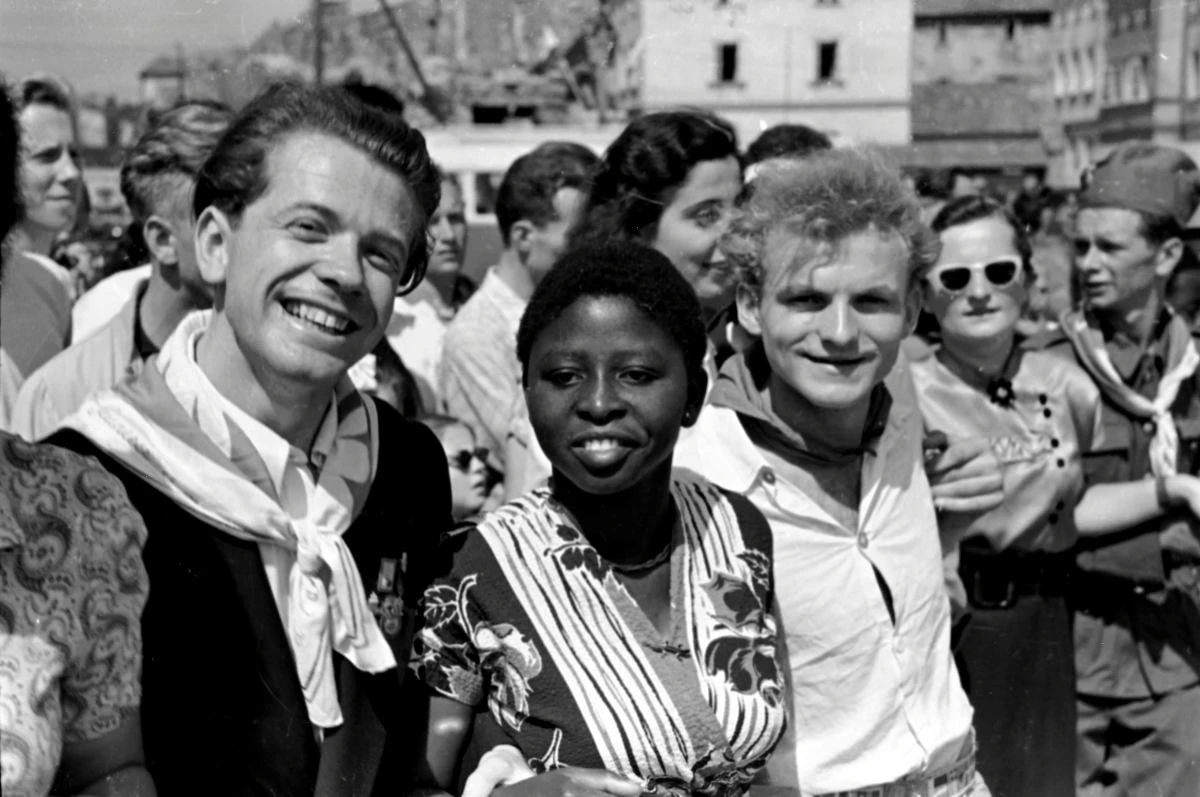
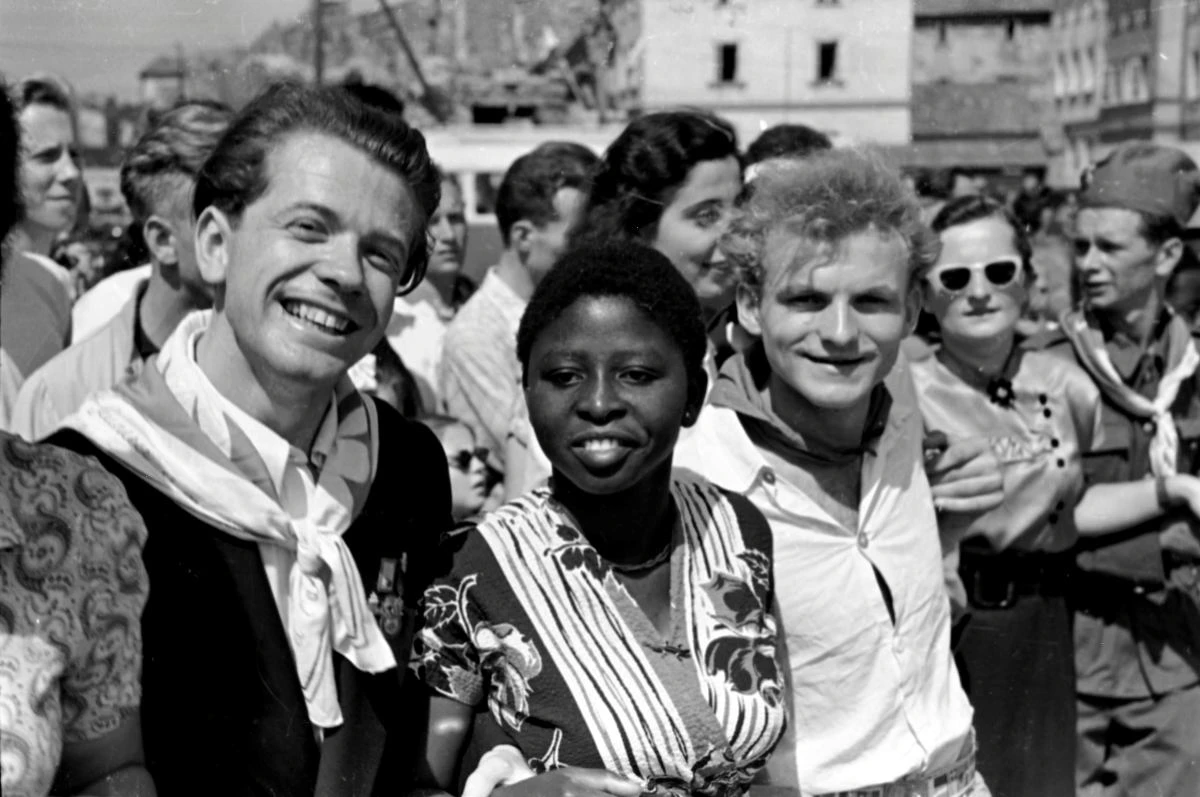
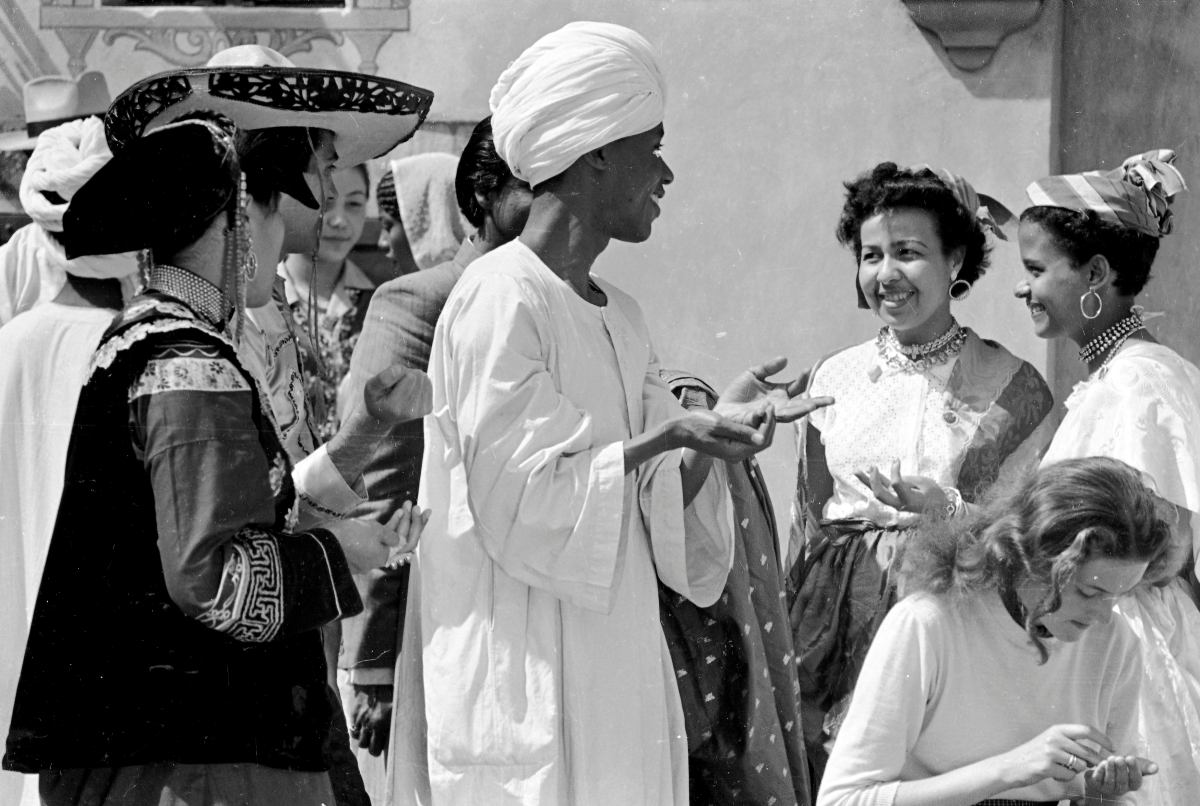
Opening image: The 5th World Festival of Youth and Students in Warsaw. A group of foreign delegates in Zamkowym Square: in the centre is Emma Okyerewa Odoi, a delegate from Gold Coast (now Ghana). Warsaw, 1955 © Zbyszko Siemaszko/ Narodowe Archiwum Cyfrowe.
[1] Bosomtwe, Oliwia (2024), Jak biały człowiek. Opowieść o Polakach i innych, W.A.B.
[2] Murzyn is a Polish word, cognate with the English Moor, that can be considered the Polish equivalent of the n-word.
[3] https://kulturaliberalna.pl/2024/09/17/sylwia-gora-recenzja-oliwia-bosomtwe-jak-bialy-czlowiek/
[4] Kobluk, Christian (2025), A Zone of Nonbeing. A Black Pole’s Reflections on Racism in Poland, Daraja Press.