
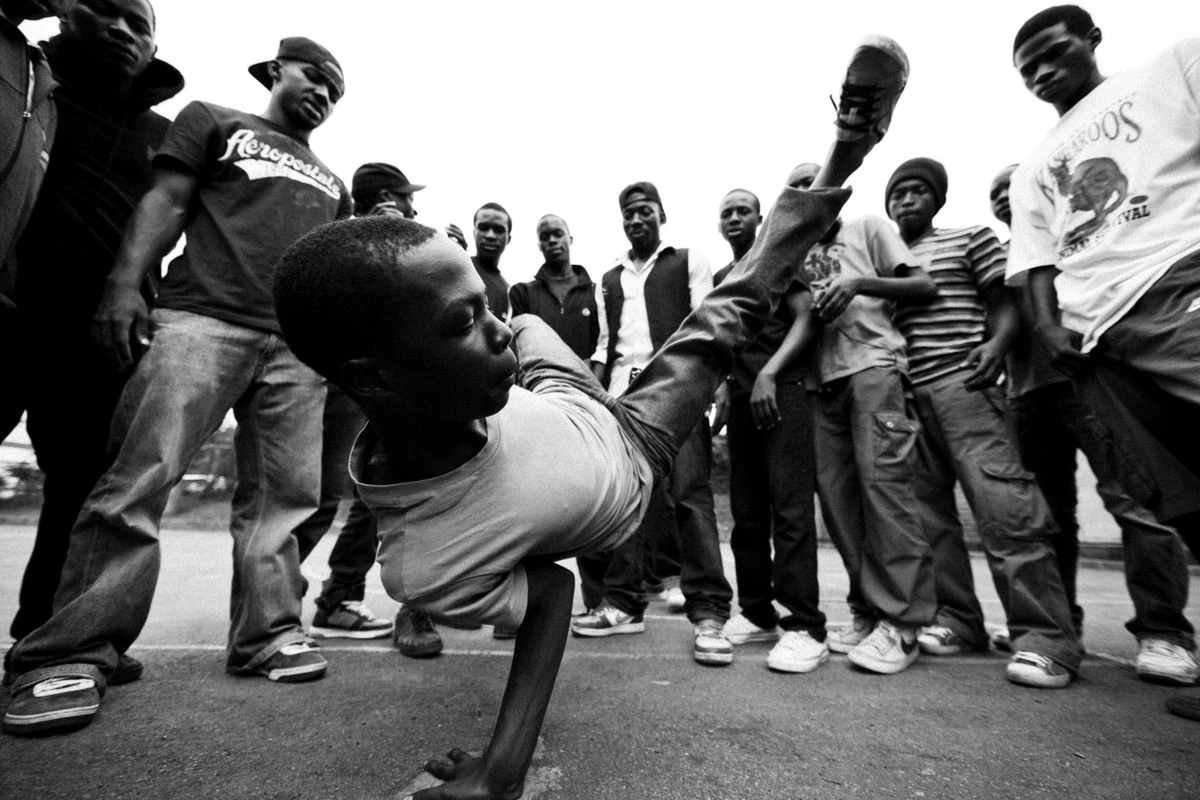
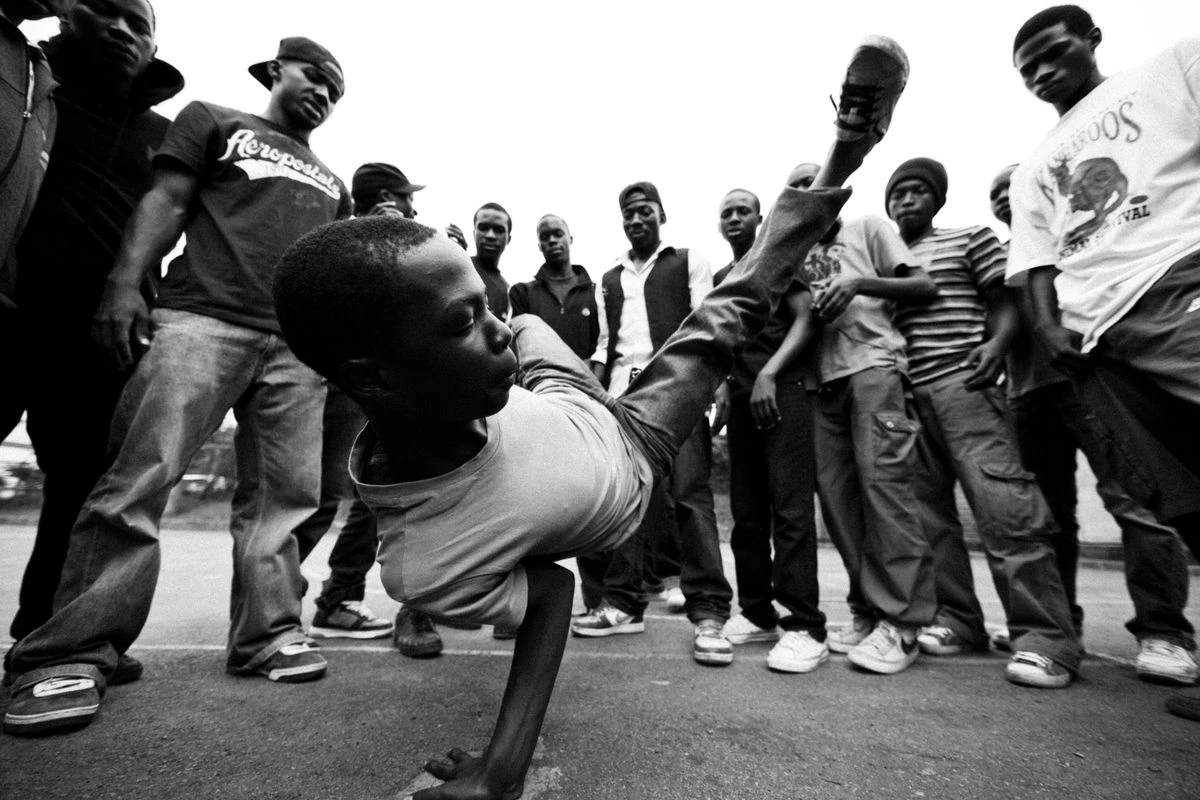
Capoeira and Breakdance: The World in a Circle

What happens when a dance born from resistance becomes an Olympic sport? From the roda of capoeira to the cyphers of the Bronx, this article traces the unexpected connection between two Afro-diasporic practices shaped by rhythm, confrontation and community: capoeira and breaking. It follows how both practices have travelled, evolved and been reclaimed as tools of identity and empowerment, while reflecting on what is gained — and what might be lost — when forms of expression born outside institutions enter the mainstream.
It was 1975 when, in state schools in the Bronx, some students witnessed something they had never seen before. Two young men brushed past each other, exchanging blows and performing acrobatic manoeuvres. Their movements flowed into one another as their bodies swayed from left to right, as if in time to the music playing from a vinyl record. They appeared to be fighting, yet they moved as if dancing to the hypnotic rhythm of metallic percussion. Once the performance was over, the pupils gathered around to speak to them. The two men did not speak English, but someone translated for them. They were Jelon Vieira and Loremil Machado, two capoeira practitioners [1].
They were the first to bring capoeira to the United States, performing demonstrations in schools and theatres. But what is capoeira?
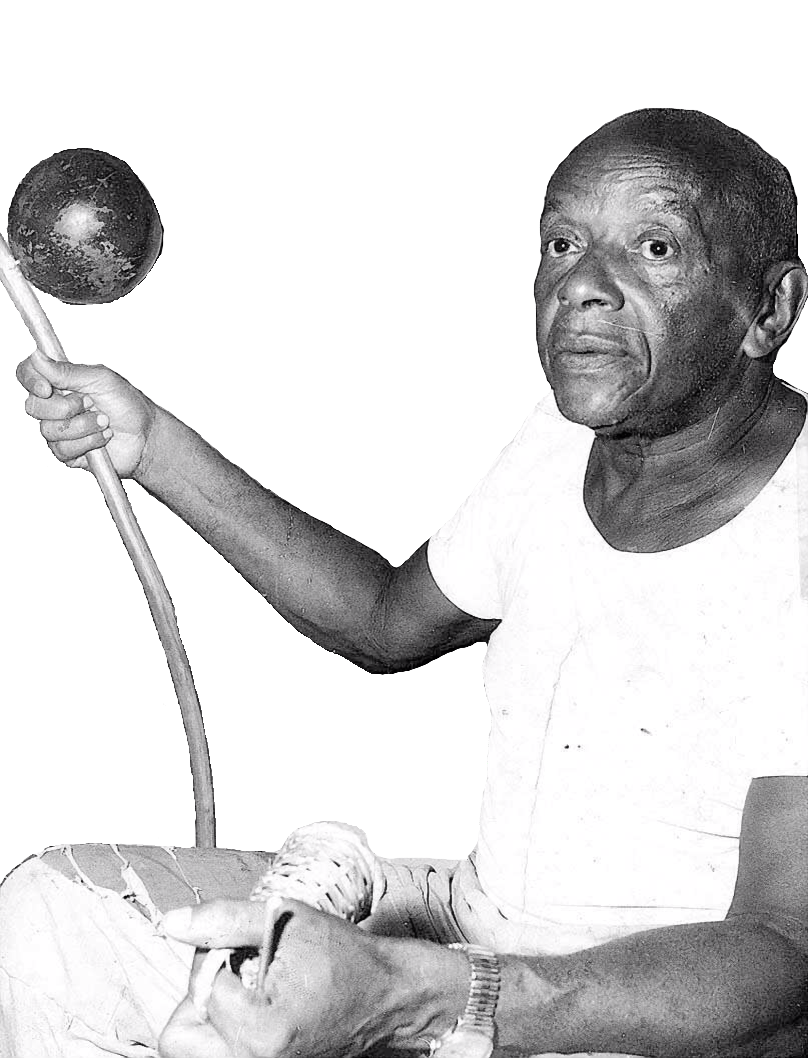
Capoeira is a practice that defies simple categorisation: it is a fight, but at the same time a dance, a ritual and, for those who practice it, a way to be in the world. It is a highly complex discipline that requires coordination, creativity and agility, but also to be able to play and sing, often all at once. Since capoeiristas train hard to learn body movement techniques and develop strategic ability and intelligence, it is considered a martial art. It is practiced in a circle formed by the participants, called a roda. From the instrumental section called bateria, at the edges of the circle, the berimbau gunga - a bow with a single string struck by a stick, played by the master or the most experienced player - starts to play: it is the instrument that leads the jogo, setting its rhythm. Also the singing begins; now the two players can enter the roda to challenge each other, spurred on by the clapping of the other capoeiristas waiting for their turn.
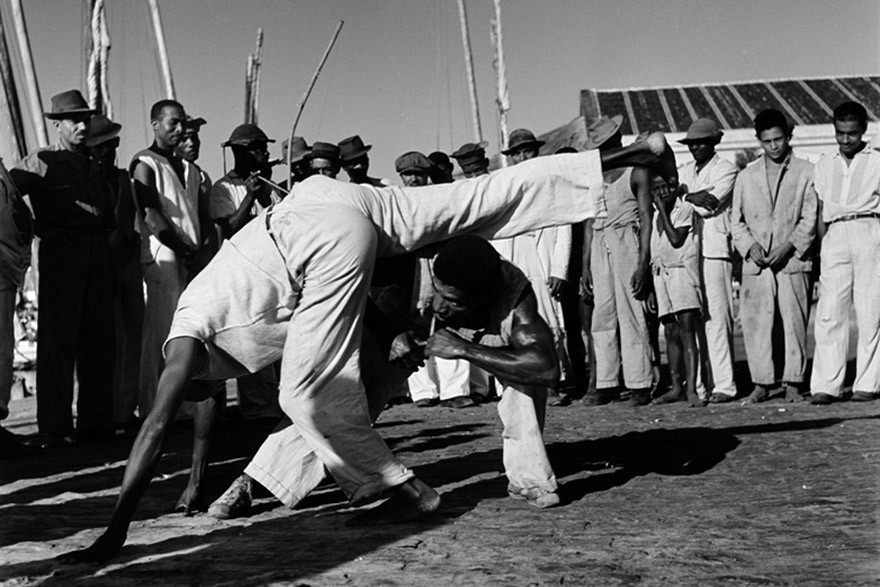
The jogo is not, strictly speaking, a fight: the goal is not to take out the opponent. It is more like a conversation, with two capoeiristas exchanging blows in a back-and-forth exchange that ends when nothing more needs to be said, or when another capoeirista wants to “have a say”. However, the form that we know today is the result of a long historic transformation.
Its history is complex, and its origins are the subject of much debate. What is certain is that it was developed in Brazil from the cultures of enslaved people. The country was in fact the main destination of the Atlantic Trade: roughly five million and a half people were deported from Africa, seven out of ten of whom were from Central-Western Africa, namely Angola and Congo [2]. Most were dispatched to knackering work on sugar and tobacco plantations and in mines in the hinterland; the others stayed in the urban areas, working as porters, dockers and sellers. In this context of forced heterogeneity and imprisonment, capoeira was born as a common cultural expression of the African diaspora, which found in syncretism and melting pot the best form for organising a resistance system of their own.
As there are not records dating from before the late 1700s, it is possible to hypothesise that, rather than something codified, capoeira initially was a plurality of different fighting styles, born from the same premises: on the one hand, the necessity of defending from the masters’ oppression and, on the other hand, the sharing of a certain expression and bodily knowledge, that can be traced back to African roots. One of the best-known hypotheses, which is still debated among scholars, traces capoeira back to the n’golo, an Angolan martial game, with which it shares some similarities in terms of movement and the ritual nature of fight [3]. According to popular narrative, enslaved people would have disguised the martial intent with dance and music to avoid arousing suspicion and being arrested. University professor and capoeirista Muniz Sodré says: «The question about the "beginning" is in a certain sense a meaningless problem. What matters most is not the "beginning" (the date and so forth do not matter so much), but the "principle": the conditions that created and kept the thing alive»[4].
The “principle” is African. The berimbau and other instruments are. The ginga, the swinging movement from one side to another which is its foundation, is a Bantu word, and it’s not the only one. And there is the Yoruba word axé, the vital energy that capoeira shares with candomblé, a religion which believes that this energy is present in all things.
Its “beginning” is Brazilian: it emerged as a form of resistance and evolved adapting to its environment, and its name, capoeira, appears to derive from the Indigenous tupi language word kaáuêra. The word was first mentioned in the sense of “fight” in 1789, when a slave was arrested in Rio de Janeiro for practicing capoeira. It continued to face opposition and, despite slavery having been abolished on 13th May 1888, it was later criminalised alongside other Afro-Brazilian practices when the new Republic of Brazil’s Criminal Code came into force[5]. In the late 1800s capoeira was practiced in several provinces, and it still was a generical term which designated different things depending on the place: often associated with street crime and the malandro figure in Rio de Janeiro, where it was instrumentalised in wars between gangs and political factions, and subjected to a subculture of violence external to the roda. As with all other African cultural expressions, it was poorly tolerated, and was usually only admitted on celebratory occasions, in a time when the myth of harmonious racial coexistence and the politics of whitening - the branquamento, namely the encouraged mixing of Black and white people to make the “negro problem” disappear - hypocritically coexisted in Brazil[6].
At the dawn of its modern history in Salvador de Bahia, capoeira was a Creole art form blending African combat systems with wider colonial and Afro-Bahian popular culture. Predominantly practised by the male descendants of enslaved people — who were now fishermen, craftsmen and dockworkers — it was a popular pastime during breaks. The state perceived capoeira as dangerous, not only as a system of self-defence, but also as an expression of resistance by a subaltern class that had eluded the violent monopoly of the ruling classes for centuries.
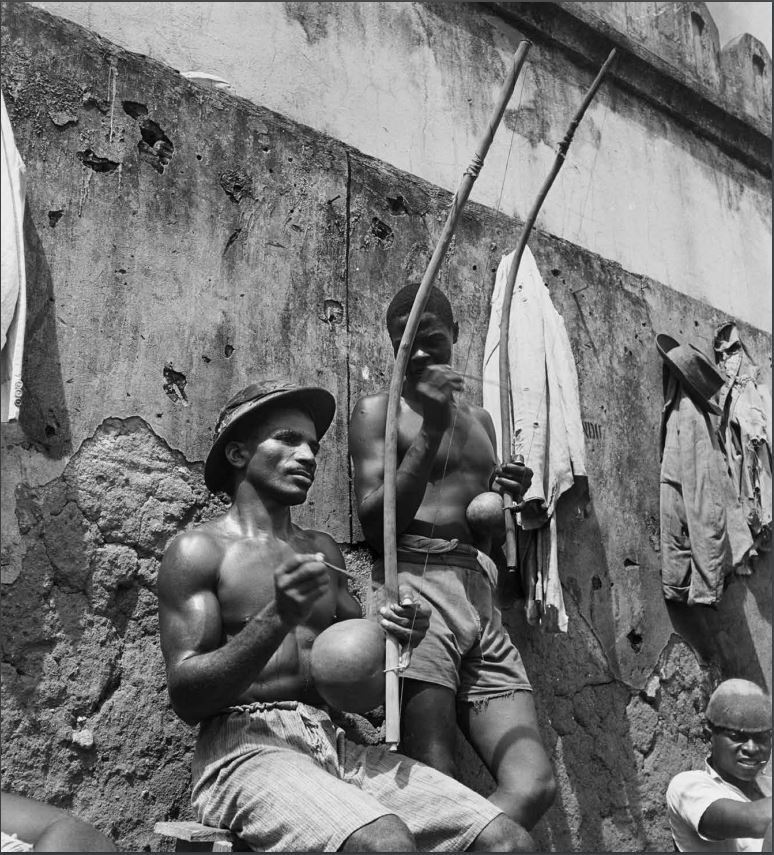
It was then that two men gave it the form we know today. In 1932, Mestre Bimba, a former stevedore, opened his first capoeira academy in town. His style, which he would call Regional, encompasses techniques from batuque and he introduced didactics for sequences of movements and progression levels. In 1941, Mestre Pastinha started to teach a capoeira which reclaims a different philosophy - loyalty to African tradition, “slow” and deceptive movements, the mandinga de escravo - and he called it Angola. This was a divergence that shaped its future. During those years, the berimbau also took on the role it plays today and music became a fundamental part of the game.
In a country celebrating racial integration under the authoritarian rule of Getúlio Vargas, the sociologist Gilberto Freyre perpetuated the myth in his 1933 book Casa-grande & senzala that everyone had equal opportunities and that Brazil was free of racism[7]. The practice that had been criminalised just forty years earlier was about to become one of the country’s symbols: in order to gain recognition, capoeira needed a new name. In 1937, Bimba’s academy was granted a licence as a centre for physical culture and, in 1953, Vargas declared that capoeira was the only truly national sport after watching him play in Salvador[8]. This inclusion stripped capoeira of its cultural and spiritual character as an art form of African descent, revealing a barely concealed racial prejudice.
This is the capoeira that children in Bronx schools will see.
Jelon Vieira explains that he struggled to promote capoeira as a martial art because the children, many of whom came from poor communities, were used to kung fu films shown in grindhouse cinemas at rock-bottom prices. Capoeira might have reminded them of breaking, so much so that, at the end of the demonstrations, the children would invite Jelon and Loremil to their cyphers, where breakers challenge one another.
Just two years earlier, in 1973, hip-hop is conventionally considered to have been born. During Bronx block parties, DJ Kool Herc would isolate the percussive section of records - the break - and extend it by playing two copies of the same track simultaneously: it was during these instrumental interludes that people would let loose and the b-boys would compete. Breaking was therefore an expression of hip-hop underground culture and the result of a creolization of African and Caribbean dances. Mambo and salsa steps, James Brown choreography and kung fu acrobatics were transformed into something new during the DJs’ breaks, at block parties or on street corners. It was practiced by young African Americans and Puerto Ricans in neighbourhoods impoverished by decades of ineffective policies, in the Bronx and Manhattan.
Jelon Vieira reports that some of his students, having been introduced to capoeira in his classes, incorporated capoeira moves into their breaking cyphers. This marked the beginning of a process that Katya Wesolowski calls “cross-fertilisation”, a mutual influence[9]. It is impossible not to notice the similarities between breaking’s footwork and the ginga, or between groundwork moves and the corta capim, freezes and queda de rins. Conversely, Crazy Legs, one of the most influential breakers of all time who rose to prominence with the Rock Steady Crew in 1979, states: «We didn't know what the fuck no capoeira was, man. We were in the ghetto!»[10]. Meanwhile, Jelon Vieira himself would jokingly claim that breakers performed certain moves, such as the pião de cabeça and the relógio, much better than capoeiristas.
As Sodré points out, also here there is a risk of losing sight of the deeper affinities. Both are Afro-diasporic inventions born from a melting pot of cultures in close contact with one another, both capable of adapting to new contexts: one is marked by slavery and oppression, while the other by repression and institutional neglect in the poor neighbourhoods of New York.
In both the roda and the cypher, the circle is a theatre of confrontation and a space temporarily removed from the hierarchies of the outside world. Those who enter it can assert their identity, test their limits, and earn recognition from the community. The audience does not remain passive; they observe, cheer on and judge, thereby helping to establish the meaning of what is happening at the centre. Therefore, the circle is not merely the spatial form shared by the two disciplines. It is also a social structure that does not draw a clear line between performers and spectators because every spectator can become a participant, and every challenge only acquires meaning in the presence of the community. The concepts and knowledge that underpin these disciplines are passed down orally and constitute genuine philosophies. In capoeira, the malícia is way more than the Italian equivalent [11]: it is an attitude that translates into physical and mental cunning, as opposed to mere strength, which allows those who can use it to beat the other in a non-violent way. It manifests itself in feints and movements designed to take the opponent by surprise. It is an “ancestral technology”. At the same time, breaking is founded on a set of strategic concepts: an attitude and a mental and physical approach that define the strategies a b-boy uses to win battles[12]. This knowledge is useful both inside and outside the circle, helping those who practise it to develop self-awareness and an understanding of their own limits. Even facing stronger opponents is a valuable learning opportunity that takes place with respect for others in accordance with the shared cultural codes.
From then on, the two disciplines remained closely linked, and their paths continued to intersect as they gained international fame. Breaking spread through films such as Flashdance (1983) and Beat Street (1984), as well as through tours: in November 1982, for example, the New York City Rap Tour, funded by the French radio station Europe 1, took Afrika Bambaataa, graffiti artists, and the Rock Steady Crew to the Bataclan and other European cities. Similarly, capoeira spread through mestres who founded schools overseas, and today Paris and Lisbon are home to some of the largest rodas outside Brazil.
The strongest resonance is felt where the population of African descent is most significant: in France and Brazil for breaking, and in African countries where the arrival of hip hop is perceived as a homecoming. The Senegalese trio Daara J titled their 2003 album Boomerang, signifying that hip hop has come full circle by returning to its roots[13].
However, this is not merely a symbolic return. In several African countries, capoeira and breaking have become tangible tools of empowerment for young people. They are accessible thanks to dedicated programmes and cultural centres, and they are also popular for reasons linked to their history: they require no special equipment or dedicated spaces, and they foster a sense of community among practitioners. The 2010 documentary Bouncing Cats follows Abramz Tekya, founder of the Breakdance Project Uganda. Established in 2006, it is a free workshop for young people living in precarious conditions. Using hip hop - and breaking in particular - it teaches them self-confidence, responsibility, and how to reduce social inequalities[14]. In a United Nations report filmed in the Democratic Republic of the Congo, where refugees from the Central African civil war have arrived, capoeira is used to convey a message of peace. Porter Kokolo Diack, a young refugee from the war, recounts: «Today, thanks to capoeira, I know how to live with a person: I know what peace means, self-control, love, respect of each other and even peaceful coexistence»[15].
The cultural significance of these two disciplines cannot be overstated. Today, there are tens of thousands of centres and schools teaching capoeira and breaking, where the values of cultural resistance that have characterised their history are passed on, values that are just as necessary now as they were then, albeit in new contexts. The most significant current challenge is ensuring that their institutionalisation does not lead to their distortion by reproducing the power dynamics to which they have always been opposed. In 1972, Mestre Bimba’s Capoeira Regional was recognised as a sport by the Confederação Brasileira de Pugilismo. However, it is no coincidence that Mestre Pastinha, who championed a form of Capoeira Angola more closely connected to its spiritual and African roots, had the premises of his school confiscated: it was never returned to him and he died in poverty in 1981. In 2024, breaking became an Olympic discipline in Paris, which raises doubts as to whether this represents democratisation or the opposite, given the costs of participation and unequal country representation due to a lack of facilities. FaBgirl, a b-girl from Brasília, is probably right: what the institutions promise to bring is already there, and nothing else is needed. «We’ve been saving lives since breaking began»[16].
Bibliography
Assunção, M. R. (2005). Capoeira: The History of an Afro-Brazilian Martial Art. London: Routledge. Barros de Castro, M. (2007). Na roda do mundo: Mestre João Grande entre a Bahia e Nova York [Doctoral Thesis]. São Paulo: Universidade de São Paulo.
Capoeira, N. (2002). Capoeira: Roots of the Dance-Fight-Game. Berkeley, CA: Blue Snake Books. Carybé. (1951). O jogo da capoeira: 24 desenhos de Carybé. Salvador: Livraria Turista.
Chang, J. (2005). Can't Stop Won't Stop: A History of the Hip-Hop Generation. New York: St. Martin's Press.
Domingues, P. (2005). O mito da democracia racial e a mestiçagem no Brasil (1889-1930). Diálogos Latinoamericanos, 6(10), 116-127.
Freyre, G. (1971). The Masters and the Slaves (Casa-Grande & Senzala): A Study in the Development of Brazilian Civilization (S. Putnam, Trad.). New York: Alfred A. Knopf.
Morgan, M., & Bennett, D. (2011). Hip-hop and the global imprint of a Black cultural form. Daedalus, 140(2), 176-196.
Schloss, J. G. (2009). Foundation: B-boys, B-girls and Hip-Hop Culture in New York. New York: Oxford University Press.
Skidmore, T. E. (1993). Black into White: Race and Nationality in Brazilian Thought. Durham, NC: Duke University Press.
Wesolowski, K. (2023). Capoeira Connections: A Memoir in Motion. Gainesville: University of Florida Press.
Roza, G. (2021, 21 January). Da quebrada pras Olimpíadas. data_labe.
Stoller, T. (2017, December). Jelon Vieira, artistic director of DanceBrazil. Profiles in Art, Westbeth Artists Residents Council.
National Endowment for the Arts. Jelon Vieira, National Heritage Fellowship.
Trans-Atlantic Slave Trade Database. Slave Voyages, Emory University.
Elderkin, N. (director). (2010). Bouncing Cats [Documentary]. Red Bull Media House. Daara J. (2003). Boomerang [Album]. Wrasse Records.
UNHCR. (2016, 4 August). DRC: Capoeira helps Central African Refugees find Peace [Video].
BBC News Africa. (2025, 6 January). The story of Capoeira: From Angola to Brazil [Video]. YouTube. https://www.youtube.com/watch?v=HE9Ps1_13Sg
[1] The account of the demonstrations in public schools in the Bronx and of Jelon Vieira’s statements is based on the interview conducted by Maurício Barros de Castro, in Barros de Castro (2007).
[2] Estimated figures for arrivals in Brazil, 1561–1856: 5,532,129 people, of whom 3,864,692 were from Central and West Africa. Trans-Atlantic Slave Trade Database, Slave Voyages, Estimates section.
[3] For the n’golo hypothesis and the objections raised against it, see Assunção (2005), chapter 2.
[4] Muniz Sodré, quoted in Capoeira (2002), p. 95.
[5] Decree No. 847 of 11 October 1890, Penal Code of the United States of Brazil, Articles 402–404 on capoeiragem and Articles 156–158 on spiritualism, magic and curandeirismo.
[6] On policies of whitening, see Skidmore (1993); on the myth of racial democracy, see Domingues (2005).
[7] Freyre (1971), English edition of the original published in 1933.
[8] The declaration dates from 23 July 1953, at the Palácio da Aclamação in Salvador.
[9] Wesolowski (2023), p. 85
[10] Crazy Legs, quoted in Chang (2005), p. 116.
[11] Malizia: malice, craftiness.
[12] On foundation, see Schloss (2009)
[13] Daara J, “Boomerang”, in Boomerang (2003). The verse is quoted in Morgan & Bennett (2011).
[14] Elderkin (2010)
[15] UNHCR (2016), min. 0:40.
[16] Fabiana Balduína (FaBgirl), quoted in Roza (2011).