
Can We Have More PDA(s)? Gatecrashing Intimacy in Nightlife Space

What makes intimacy possible in public? In his latest article for oltreoceano, Michael explores Black nightlife, queer party culture, and the fragile conditions that allow people to feel seen, connected, and at ease with one another. Moving between Looking for Langston, Lovers Rock, and the photographic archive of Liz Johnson Artur’s PDA, the piece reflects on how spaces of belonging are built, maintained, and experienced. Not as escapes from the world, but as collective structures that make intimacy possible, even if only temporarily.
In Isaac Julien’s Looking for Langston (1989), a dance floor unfolds almost like a suspended world. Essex Hemphill’s poem recitation The Brass Rail’ Call and Response with Wayson Jones mixed with Can You Party (Club Mix) by Royal House hold everything together. People move through the space in ways that feel immediate, leaning into each other, touching, resting, circulating without explanation. For a moment, intimacy doesn’t need to be justified. It just happens.
But that feeling never fully settles. Even in the middle of that immersion, there is a sense that the space could be interrupted at any point. It is never fully sealed from what exists outside it. Something about it always remains slightly exposed.
That tension between immersion and fragility is where this essay begins.
Black nightlife spaces, Black rave spaces, Black queer party spaces are often described as escapes. But that word doesn’t really hold if you stay with them for long enough. They are more like temporary structures that people build together. Spaces where closeness, visibility, and belonging become possible for a while, but only under specific conditions.
We already see this pressure in Steve McQueen’s Lovers Rock (2020), where simply gathering becomes something watched and questioned. Space is never neutral. It is always already shaped by surveillance, suspicion, and uneven visibility. While not a film about nightlife in the narrow sense, it stages something closer to the conditions under which Black social space is always already read. This reading is often literal and bureaucratic; for years, the Metropolitan Police’s ‘Form 696’ acted as a gatekeeping mechanism, disproportionately targeting events featuring R&B, Garage, effectively policing Black sociality under the guise of risk assessment.
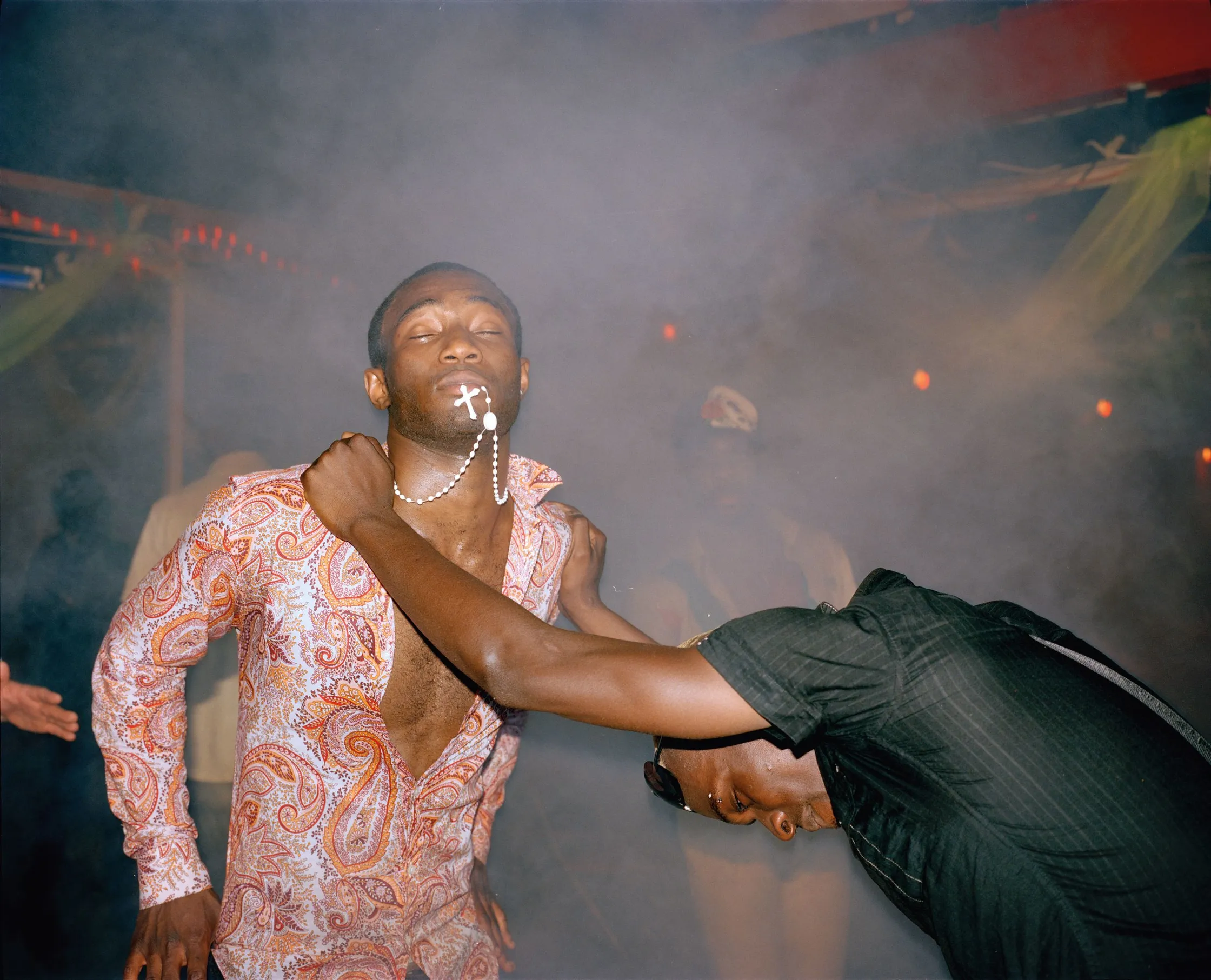
It is within this broader understanding of nightlife as something produced, not given, that Liz Johnson Artur’s PDA becomes central. The acronym PDA is believed to stand for Public Display of Affection, Please Don’t Ask, Panic Disco Arena, or even Pretty Dick Available. It was a London nightlife legend, a Black, Brown and Queer party that took place from 2011 to 2021 documented through the lens of the photographer, Liz Johnson Artur.
Nightlife is often spoken about as something open, fluid, or naturally communal. But that framing hides how much work actually goes into holding these spaces together. This work is increasingly precarious in a city like London, which saw a 50% loss of nightclubs and a 58% decline in LGBTQ+ venues between 2006 and 2017 according to UCL’s Urban Laboratory. These spaces don’t exist outside structure. They reorganise it temporarily and that already changes how we think about intimacy inside them.
Across different contexts, from clubs to raves to queer parties, what we call “the vibe” is not spontaneous. It is produced. Through sound, through bodies, through unspoken rules, through who is there and how they move.
This idea resonates with what Professor Alexander G. Weheliye describes in his broader work on Black sound, embodiment, and sonic life, particularly in his discussions of how Black cultural expression often operates through forms that exceed formal visibility or institutional recognition. In his account, sound and rhythm become ways of producing sociality that are not fully captured by dominant spatial or visual regimes.
If we extend this line of thinking to rave and nightlife culture, Black and diasporic club spaces can be understood as environments where sound does not simply accompany movement, but actively produces forms of collective relation. In this sense, the dance floor is not just a place where bodies gather; it is a sonic structure that makes certain kinds of gathering possible in the first place.
From this perspective, what we call “Black rave space” is not only spatial but also sonic and affective. It is produced through rhythm, bass, repetition, and shared bodily alignment. These elements create a form of social coherence that does not rely on formal permission or institutional validation, but on embodied participation.
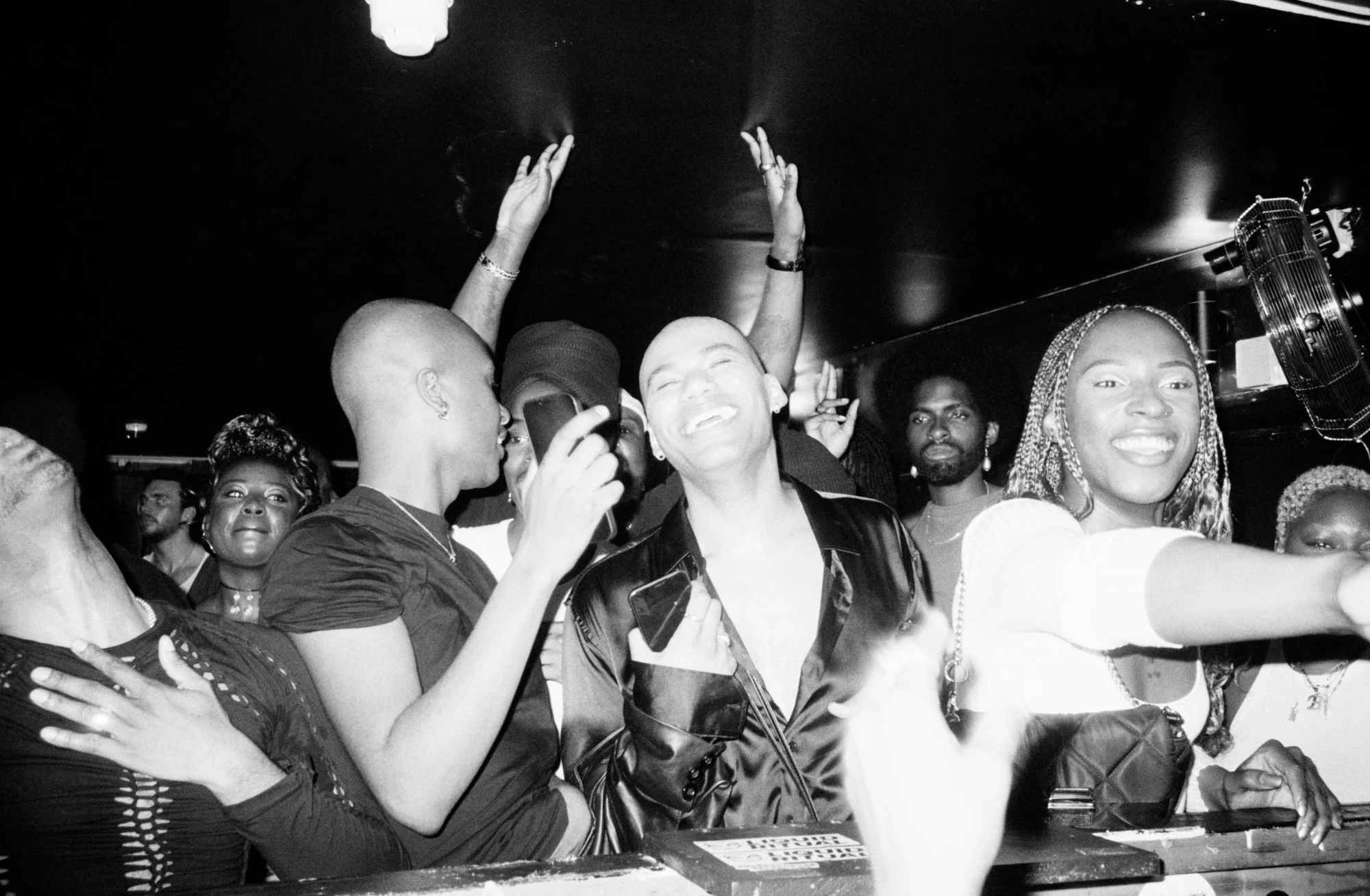
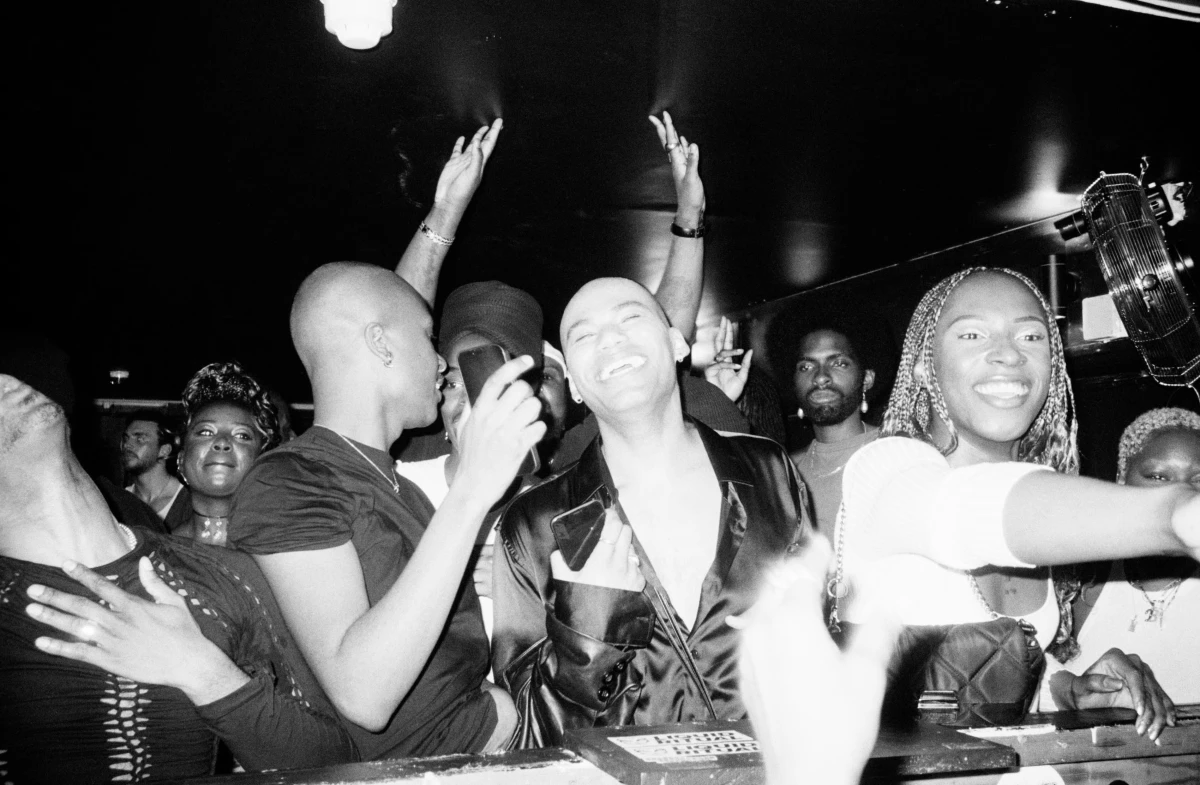
Liz Johnson Artur’s PDA does not present intimacy as something exceptional. It shows bodies close together, leaning, touching, resting into each other, moving through nightlife environments in ways that feel almost effortless. At first glance, it looks like spontaneity. However, that reading starts to fall apart once you sit with it. What you are actually seeing is not just affection, but what a space allows to happen. PDA, then, is not simply what people do in public. It is a condition of spatial permission. A way of being together that only becomes visible when certain atmospheres are already in place. That shifts everything, insofar as intimacy stops being purely personal. It becomes something produced through environment, recognition, and a shared understanding of how to be in a space.
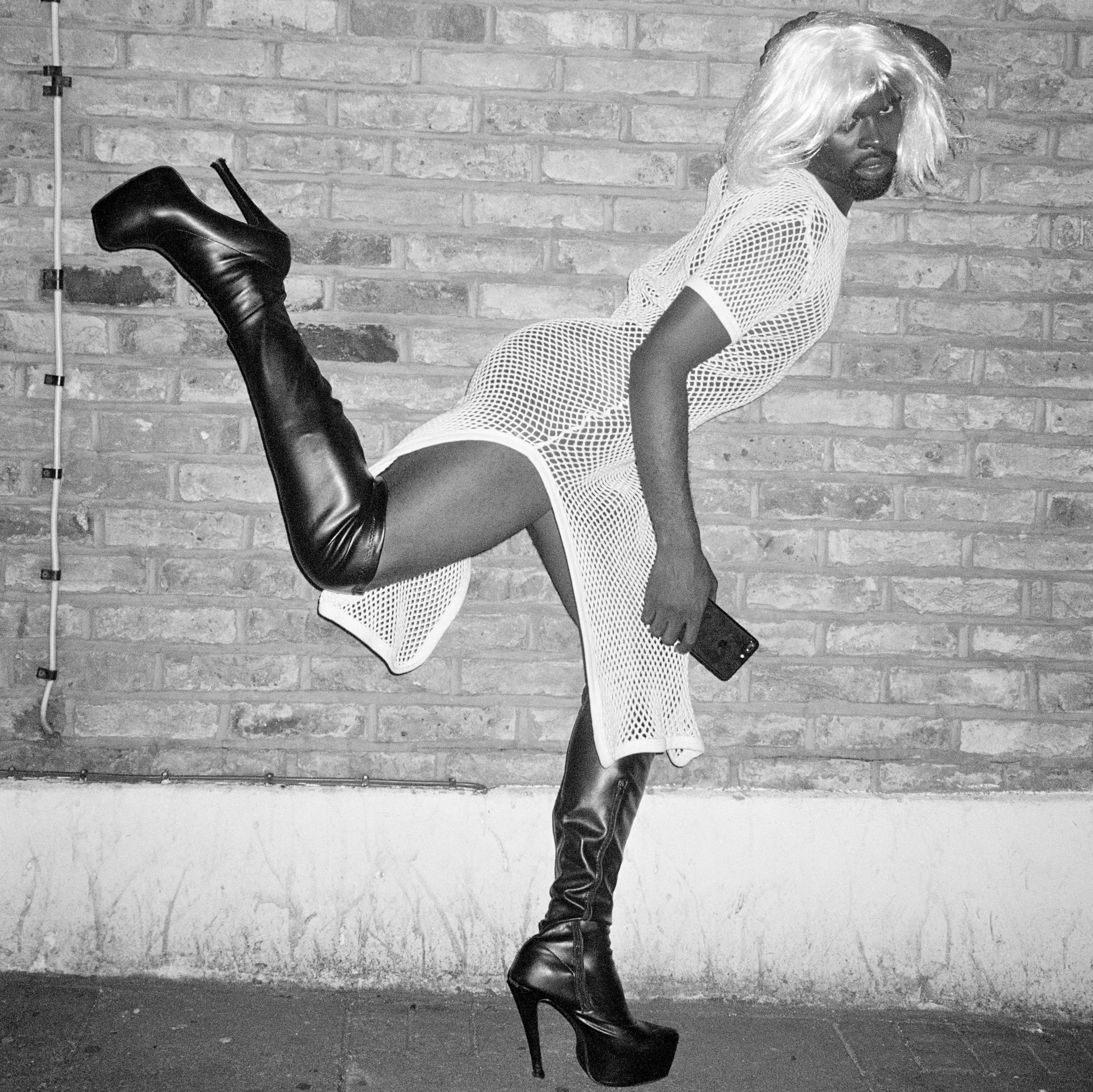
An important detail here is that Liz Johnson Artur is not outside these environments. She is inside them, inasmuch as her camera is too. That matters more than it sounds, because it means the images are not taken from a distance. They are made from within a space where the photographer is already permitted to be present, not as surveillance or extraction, but as someone who has access.
So even the act of photographing intimacy is part of the same structure. It depends on trust. On recognition. On belonging that is already negotiated before the image is taken. What can be seen is therefore inseparable from who is allowed to see, and from who is recognised as belonging within that field of visibility Nightlife culture becomes especially important here in a more grounded sense.
In writing and interviews around London party culture such as A Thread about the party that birthed London’s best fashion talent, what becomes clear is that these spaces are not the product of a single origin or a single “founder.”
They are built collectively. Ms. Carrie Stacks, alongside figures such as Mischa Mafia, Akinola Davies Jr, Siobhan Bell, all appear not as singular creators of a space, but as part of a wider network of organisers, DJs, and cultural workers who shaped how those environments felt from the inside. What matters is not who “owns” the space, but how it is made: through decisions about music, crowd, tone, aesthetics, and who feels comfortable enough to stay. These parties were never neutral. They were carefully constructed environments, shaped by Black, Brown, queer, and working-class creatives who actively produced the conditions for belonging and not just attended them.
And that changes how we think about intimacy again, that is, if the space is made collectively, then intimacy inside it is also indirectly shaped by that collective labour. PDA does not float freely. It is supported by the people who hold the room together. My own experience in nightlife spaces doesn’t always match the ease these images suggest. There are moments where everything aligns. Where movement feels natural. Where you don’t think too much about how you are occupying space.
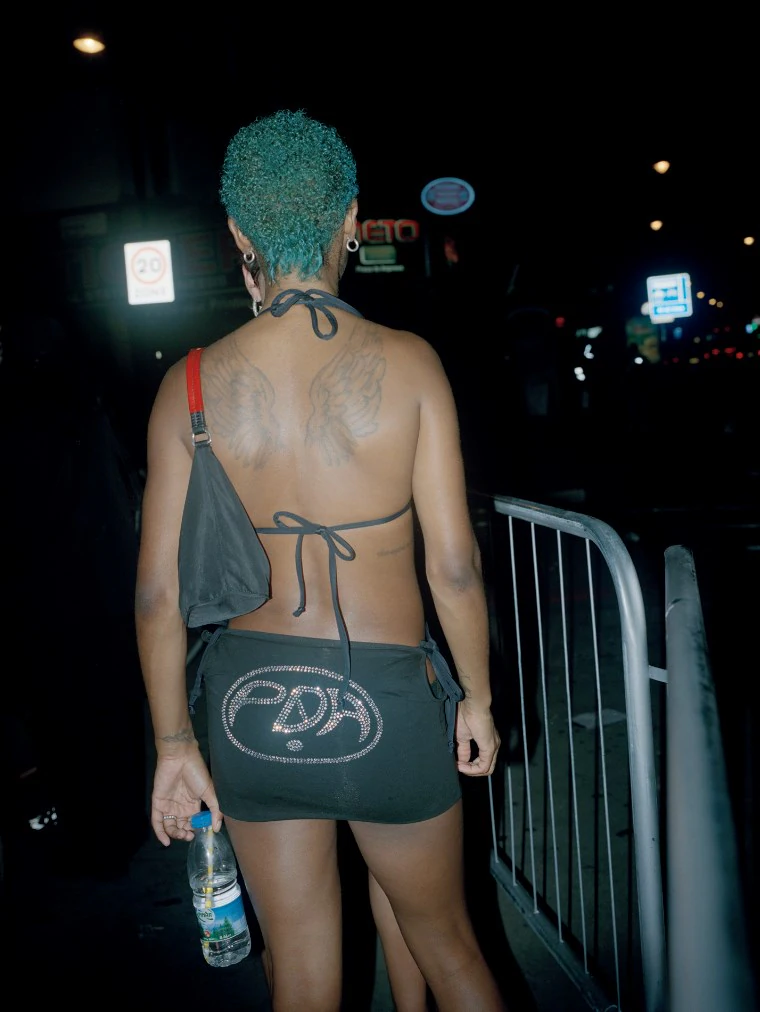
And then there are other moments where something feels slightly off. Not exclusion in any direct sense, but a quiet awareness that others seem more fluent in the space. More settled. More at ease with how intimacy circulates around them. That difference is subtle, but it changes how you experience everything. It makes you notice that belonging is not automatic. It is something produced in real time, through recognition, familiarity, and shared codes that are not always spoken. This is where the idea of “gatecrashing” becomes useful but not in a literal sense.
Not as breaking in, but as a misalignment and more precisely, as a feeling of being slightly out of sync with a space that is already in motion. You are inside it, but not fully aligned with how it is structured. That feeling doesn’t sit outside the space. It reveals how the space is already organised. In Looking for Langston, the dance floor never fully closes itself off from the outside. Even when it feels complete, it remains exposed. That exposure is not always visible, but it is always there. Which means intimacy is never fully secure. Not because it fails, but because it depends on conditions that have to be continuously held in place. It depends on attention. On recognition. On shared presence that can shift at any moment.
Gatecrashing, in this sense, is not an exception to intimacy. It is part of its structure. It names the fact that spaces of belonging are always slightly unstable. Always partially exposed to forces that exceed them.
So, how does the question “Can we have more PDA(s)?” feel?
At first, it sounds like a simple desire for more openness. More visibility. More public affection. However, that reading becomes too simple as more visibility doesn’t automatically produce intimacy, and expanding access doesn’t necessarily create belonging. If anything, changing the scale of visibility also changes the conditions that make intimacy possible in the first place.
In Liz Johnson Artur’s PDA, what we see is not just affection in public. It is intimacy that exists because a specific kind of space has been built and sustained long enough for it to happen. Spaces that are uneven. Carefully held. Sometimes welcoming, sometimes misaligned, always dependent on who is present and how they are allowed to be there. So maybe the question is not really about having more PDAs. Maybe it is about noticing what kinds of spaces make them possible at all and how fragile those spaces actually are.
References
Alexander, Claire. The Art of Being Black: The Creation of Black British Youth Identities. Oxford University Press, 2010.
Gilroy, Paul. The Black Atlantic: Modernity and Double Consciousness. Harvard University Press, 1993.
Weheliye, Alexander G. Phonographies: Grooves in Sonic Afro-Modernity. Duke University Press, 2005.
Weheliye, Alexander G. Habeas Viscus: Racializing Assemblages, Biopolitics, and Black Feminist Theories of the Human. Duke University Press, 2014.
McRobbie, Angela. Club Cultures: Music, Media and Subcultural Capital. Polity Press, 1999.
Thornton, Sarah. Club Cultures: Music, Media and Subcultural Capital. Wesleyan University Press, 1996.
Julien, Isaac, dir. Looking for Langston. 1989.
McQueen, Steve, dir. Lovers Rock. 2020.
Campkin, B., & Marshall, S. LGBTQ+ Cultural Infrastructure in London: Night venues,
2006-2017. UCL Urban Laboratory, 2017.
Greater London Authority. London’s Night-Time Economy. (Providing the 50% nightclub
loss statistics), 2017.
Talbot, D. "Regulating the Night-Time Economy." In: Nightlife and Crime. (Regarding
Form 696 and the policing of Black music genres), 2011.
UK Music & London Assembly. The Impact of Form 696 on London’s Grassroots Music.,
2017.
Johnson Artur, Liz. PDA. Photographic publication, 2025,
Georgia Graham, “A Thread about the party that birthed London’s best fashion talent.” https://threadsofconversation.substack.com/p/a-thread-about-the-party-that-birthed