
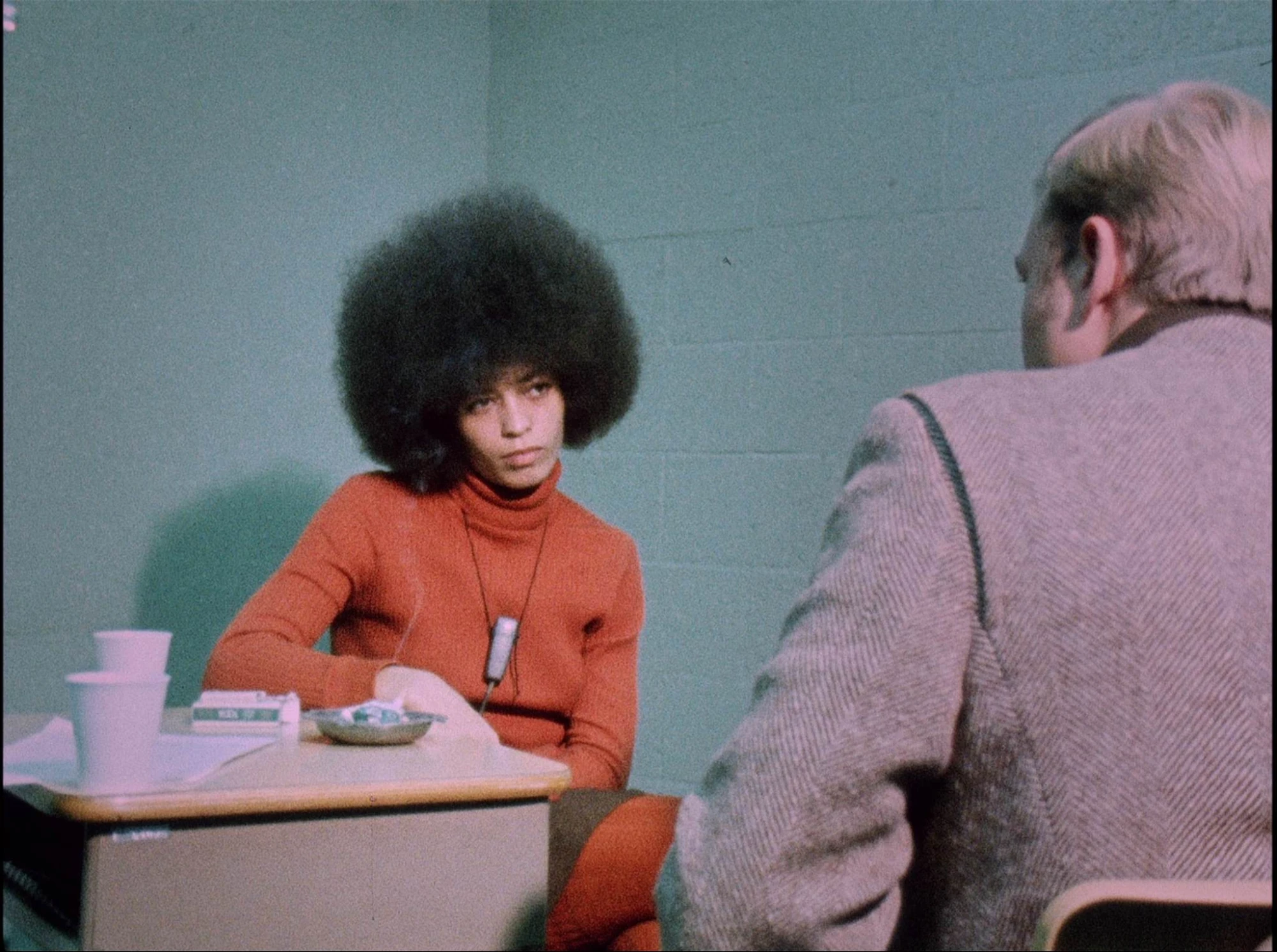
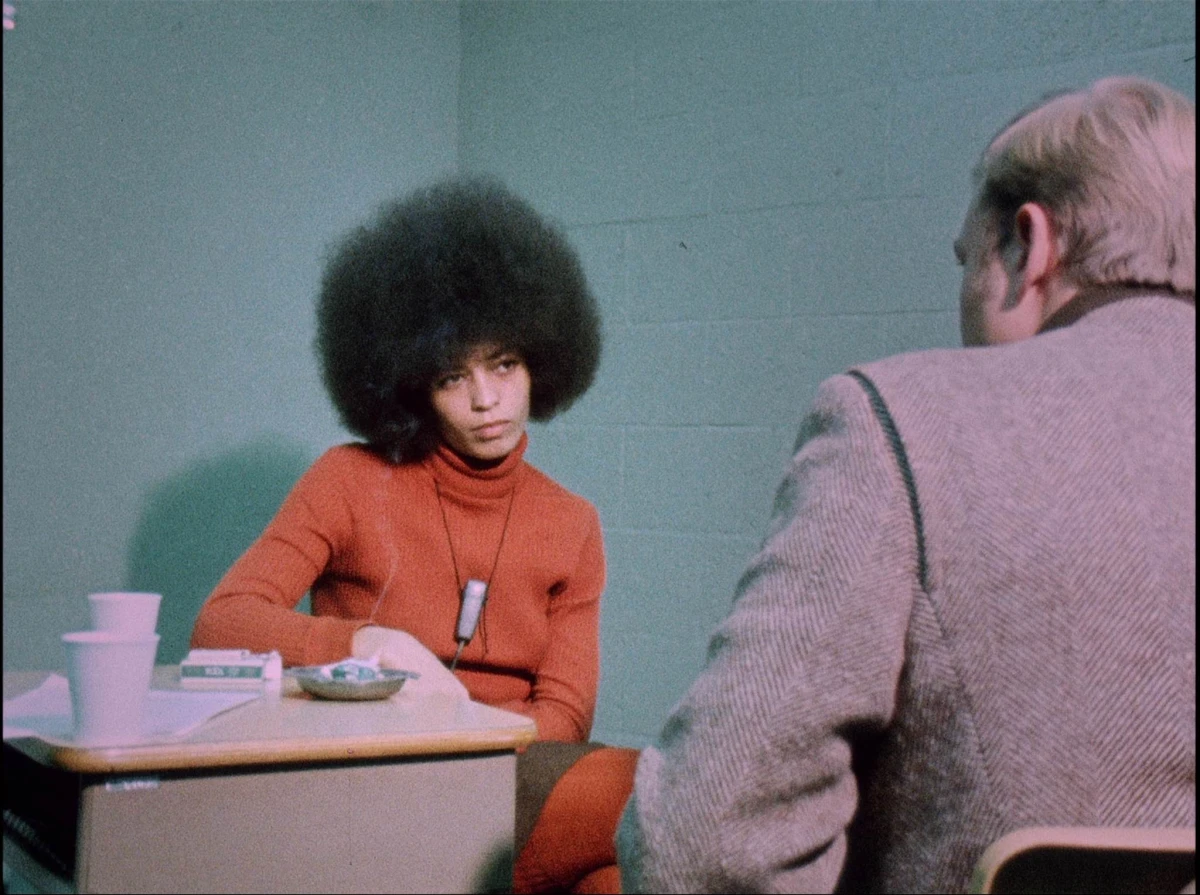
Who is the Room Built For?

Following Angela Davis’s talk at Cinema Godard, Fondazione Prada, in Milan, author Naomi Kelechi Di Meo reflects on the significance of the philosopher and activist’s presence in the city, and on the contradictions of cultural institutions that celebrate Black intellectual voices while continuing to marginalise the communities behind them. Moving between personal gratitude and collective critique, she questions the difference between consuming radical thought and embodying it, and considers what it means to put the lessons of liberation into practice.
I am slowly coming up for air after a weekend of extraordinary encounters, collective action, and necessary confrontation. I am still sitting with many of the emotions that accompanied these past few days, trying to make sense of what it meant to experience them, both personally and collectively.
There is something deeply moving, almost surreal, about seeing Milan host two figures who have shaped, and continue to shape, the ways I understand my own existence, our bodies, our histories, and the lands we struggle to call our own.
In two different yet profoundly interconnected realms, Professor Angela Davis and filmmaker Haile Gerima occupied space in this city, sharing their political imagination, and their lifelong commitments to liberation. For a moment, I found myself sitting across from people with whom I had spent years having imagined conversations through books, films, lectures, and the political traditions they helped build. There is an intimacy in finally encountering someone whose work has accompanied you for years, often without them knowing how much of yourself you have found in their words and images.

For Black and Brown Italians, opportunities like these are neither frequent nor guaranteed. Many of us have grown up politically and culturally looking beyond the borders of this country, searching for the language, histories, and frameworks through which we could understand ourselves. In this sense, oltreoceano exists precisely at this intersection, where the possibility of looking overseas, of reading, studying, questioning, and challenging the codes through which we have learned to see and recognise one another meets the necessity of producing our own images, our own narratives, and our own political identities. There is a particular contradiction in having to look elsewhere to find the intellectual and cultural tools to make sense of one's own existence. But there is also extraordinary power in the relationships, political solidarities, and communities we have built from that distance, refusing to be confined by national borders. In a country where our bodies are so often treated as sites of production, extraction, and consumption across creative, cultural, and political spaces, this weekend was an important opportunity to come together, look one another in the eyes, and exchange knowledge beyond the terms imposed on us.
And if there is one thing we have learned, often at our own expense, it is that community cannot be built without us, nor can it be built for us by institutions that remain unwilling to confront their own structures. The luxury of relying on external bodies to recognise, legitimise, or - God forbid - make space for our existence has too often come at the cost of exploitation, and the reproduction of the very systemic injustices we are trying to dismantle.
This is why the event at Fondazione Prada was met both with gratitude and criticism, but certainly not surprise.
While we recognise the significance of an institution bringing Angela Davis to Milan, we cannot ignore the contradictions of hosting a Black revolutionary intellectual within a cultural infrastructure that continues to marginalise the very communities whose histories, struggles, and political labour make such conversations possible.
The contradiction became even more evident when Black and Brown communities in Milan found themselves having to choose between two historic Black anticolonial figures, Angela Davis and Haile Gerima, whose events took place in the same city. That choice was not simply an unfortunate scheduling conflict. It exposed a broader failure to recognise and engage with the networks of Black and Brown cultural workers, collectives, organisers, and intellectuals who have been active in this city for years.
How can institutions celebrate Black radical thought while continuing to exclude Black and Brown communities from the processes through which that thought is presented, circulated, and legitimised?
This was the question we brought into the room.
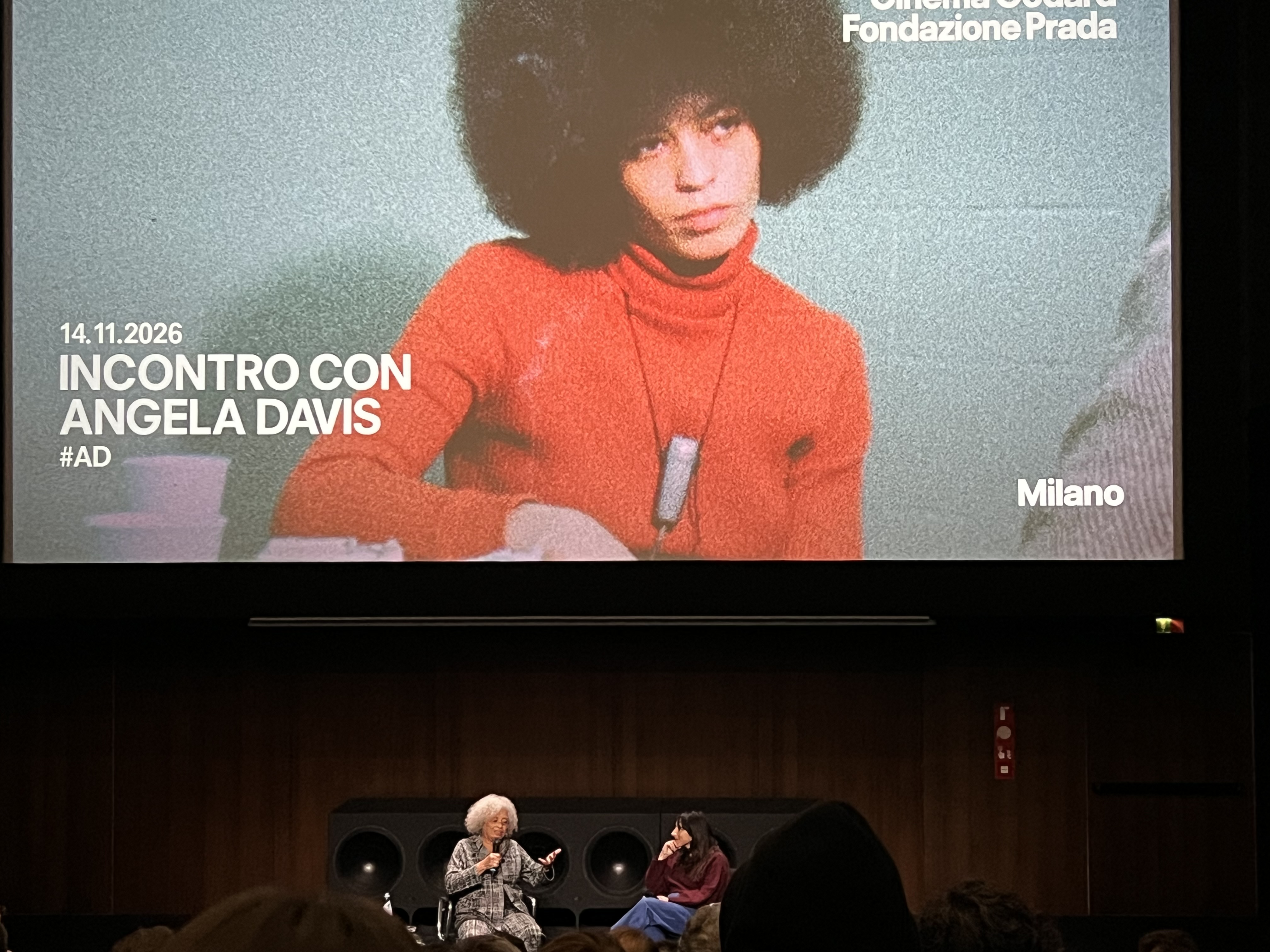
During the screening presentation at Fondazione Prada, a fellow sister read a letter addressed to Professor Davis and the institution, collectively authored by a group of Black and Brown women, denouncing a pattern that has become painfully familiar. Both the writing of the letter and the organisation of the public intervention were the result of a shared effort, grounded in our lived experiences, conversations, and collective intellectual and political labour.
It is important to me to recognise the collective nature of this action. What was articulated in that room did not belong to any one of us individually. It emerged from years of shared experiences, frustrations, mutual care, and political organising, from conversations that have taken place long before Angela Davis arrived in Milan. We chose to intervene publicly rather than only confine our concerns to an email, a private exchange, or another conversation behind closed doors. The issue was never simply one of communication. It was, and remains, a question of power, access, accountability, and the infrastructure through which culture is produced.
As we collectively stated in the letter,
“We are not asking to be represented. We are demanding to be involved in any political and cultural dimension centered on our lives and our stories.”
This distinction matters because representation has become one of the most convenient languages through which institutions can claim progress without redistributing power. It allows Black and Brown people to be visible without being heard, celebrated without being consulted, and placed at the centre of a cultural programme while remaining at the margins of its decision-making structures. Involvement, on the other hand, requires something far more uncomfortable. It requires institutions to acknowledge the cultural and intellectual labour already taking place outside their walls, to build relationships that are not merely transactional, and to relinquish some of the authority they have historically claimed over whose knowledge is valuable, whose voices deserve amplification, and under what conditions. Our intervention was therefore not a rejection of Angela Davis’s presence… quite the opposite. It was an attempt to take seriously the political commitments that her work demands of us.
On a more personal level, it is difficult for me to articulate how much I owe to Professor Davis. Not only as a student of decolonial thought, Black studies, and critical race theory, but as someone who has admired her for years. So much of my political vocabulary, the questions I ask, the contradictions I have learned to recognise, and the ways I understand liberation have been shaped by her writings and struggles. Her work has given me language for things I have lived, felt, and struggled to articulate.
Sitting in front of her, I was reminded of the urgency of connecting struggles against racism to the critique of capitalism, of understanding communism not as an abstract ideological reference but as part of a broader political imagination concerned with collective liberation. It was also a reminder that justice must remain the central political demand, rather than being displaced by the increasingly hollow vocabulary of diversity, equity, and inclusion. But perhaps what stayed with me most, and what I find myself returning to in these days, was something less easily translated into institutional language. The importance of remaining stubborn. The courage to confront and dismantle systems of oppression without waiting for permission. The refusal to confuse politeness with political responsibility; the willingness to be controversial, and perhaps especially to act when controversy becomes inevitable.
I think often about what it means to inherit these teachings and how much more difficult it is to embody them than it is to study them. Because what is the purpose of engaging with radical political thought if we are unwilling to confront the contradictions of the spaces in which that thought is being consumed?
Our intervention was not welcomed by everyone in the audience. The discomfort was palpable... and that was precisely the goal.
There is a particular comfort in sitting inside a prestigious cultural institution, listening to a Black revolutionary intellectual speak about liberation, and believing that the act of listening is itself a political commitment. As though proximity to radical thought could substitute for political action. As though the presence of a Black voice in a predominantly white room could somehow absolve that room of the need to question its own composition, its conditions of access, and its structures of power.
Listening to Angela Davis is not the same as practising what Angela Davis has spent her life teaching us. And if the presence of Black and Brown women demanding accountability disrupts the experience of consuming Black radical thought, then perhaps we should ask what exactly the audience came to hear, and what it was prepared to confront.
The same questions extend beyond Fondazione Prada. They concern the broader cultural landscape of Milan, a city that increasingly positions itself as an international centre of culture, creativity, and progressive ideas, while so much of the labour of building genuinely inclusive political and cultural spaces continues to fall on communities working without institutional recognition, resources, or sustained support. It is precisely in this context that the presence of Haile Gerima carried such significance. His cinema has long insisted on the necessity of reclaiming our histories, resisting dominant narratives, and developing autonomous forms of cultural production. His work reminds us that the struggle over representation is also a struggle over who holds the camera, who tells the story, who controls the means of production, and who gets to imagine the future.
I do not believe that every political intervention must be comfortable, universally understood, or immediately celebrated to be necessary. Nor do I believe that gratitude should require silence. I can hold the profound emotion of finally encountering figures who have shaped my life alongside the frustration of continuing to navigate institutions that reproduce the conditions their work teaches us to question. These feelings are not mutually exclusive. If anything, we owe it to their work, and to ourselves, to hold them together. Right?
I am coming away from this weekend with immense gratitude for the knowledge shared by Angela Davis and Haile Gerima, but also with a renewed conviction that political education means very little if it does not translate into collective practice.
Beyond the privilege of encountering these two extraordinary figures, what I will carry most intimately with me is the experience of standing alongside other Black and Brown women. The conversations that preceded our intervention, the trust we placed in one another, the care with which we collectively articulated our demands, and the knowledge that none of us had to stand alone. I am reminded that we are not simply asking to enter rooms that were never built with us in mind. We are questioning the foundations upon which those rooms stand, while continuing to build spaces of our own.
And if this weekend reminded me of anything, it is that solidarity is not something we merely speak about in the presence of revolutionary figures. It is something we practise, collectively, even and especially when doing so makes the room uncomfortable.
It is in this collective practice that I find the most meaning, and it is with a profound sense of gratitude and political conviction that I take pride in the collective action and effort undertaken alongside my fellow sisters and comrades.