
Americans Always Need to Idealize. Retracing Pier Paolo Pasolini’s 1966 Trip to New York

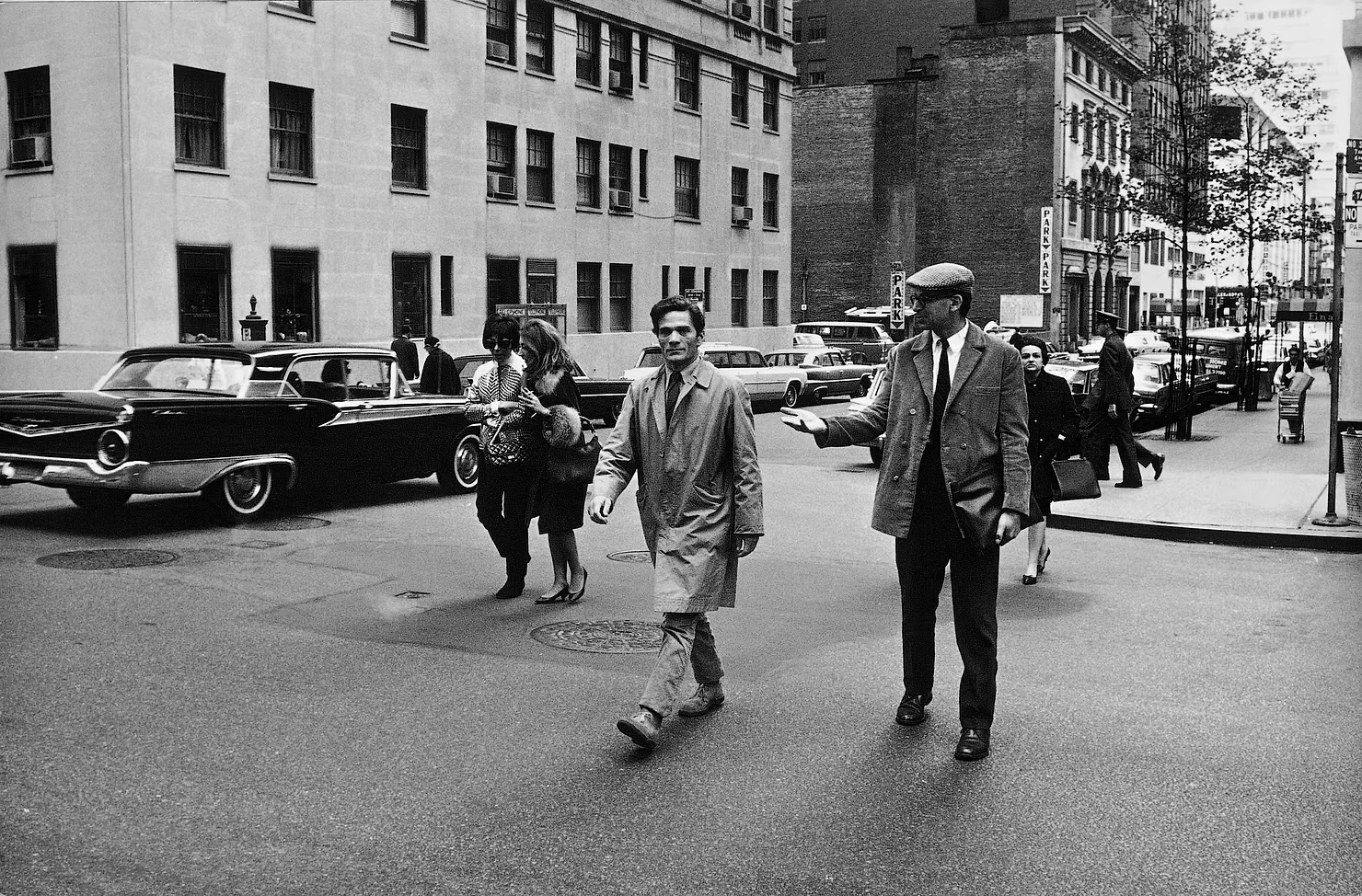
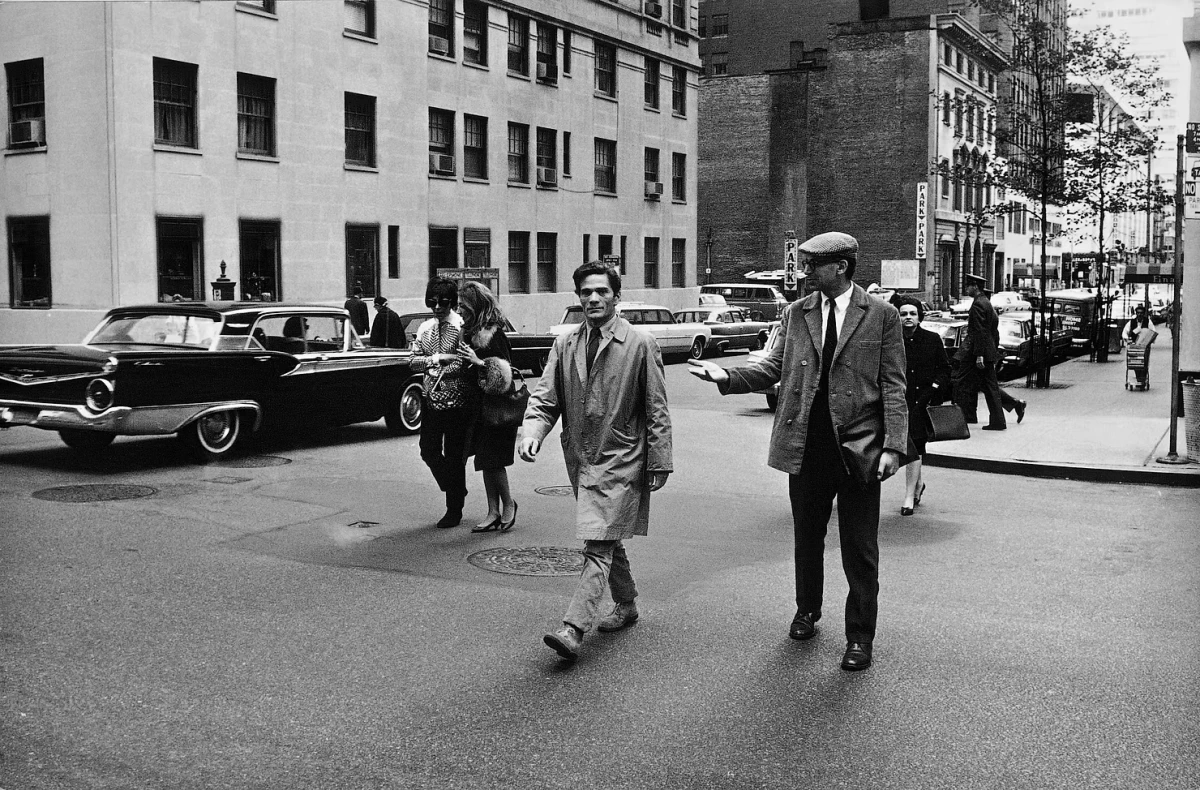
What did Pier Paolo Pasolini see in America? In 1966, Pasolini arrived in New York expecting to encounter the heart of American capitalism. Instead, he found a country that fascinated him: young, contradictory and shaken by the Civil Rights Movement, opposition to the Vietnam War and the emergence of the New Left. For Pasolini, the United States was a society without the class consciousness of European Marxism, yet seemingly charged with a revolutionary energy that Europe itself was losing. At the centre of this contradiction was race: from the Black freedom struggle to the poverty of the Bronx, Pasolini began to read New York through colonialism, Fanon and the struggles of the Global South. In a new article for oltreoceano, Mattia Marzà retraces Pasolini’s 1966 journey through New York to explore his fascination with America and the contradictions of a thinker whose political legacy is still contested today.
A twisted legacy
In the fictional Sicilian town of Regalpetra, it is election day, and pool supervisors are repeatedly presented with an eerie scene: every few minutes, some cars – always the same ones, with the stickers of the Christian Democracy and Italian Social Movement (neo-fascists) parties on their radiators – disgorge several old people, often confused and absent-minded, who are later escorted by some activists to the pool. Communist activists try to stop this fraud, which they ironically define corpse-carting, but they usually don’t succeed. However, sometimes these attempts at deception fail; and a neo-fascist activist discovers malgré lui that the elder woman he escorted is actually about to vote for the C.D. rivals, as instructed by the nuns, who managed to kill two birds with one stone: they earned a precious vote, and they dumped the transport costs to the neo-fascists[1].
This unforgettable scene is depicted by Leonardo Sciascia in his 1956 debut book, Le Parrocchie di Regalpetra, where the author provides detailed descriptions of specific Sicilian settings, including primary schools, sulphur springs, bourgeois social clubs and elections. Halfway between a memoir and a political essay, the book had extraordinary success and persistence; and many sketches excerpted from it were later quoted by other Sicilian authors, including Giuseppe Tornatore in his 2009 movie Baarìa[2]. The film, which recounts the story of the Torrenuova family of Bagheria (Palermo) from the 1930s to the 1980s, stages precisely this episode, but, despite the stylistic continuity, its meaning is reversed: in fact, it is the protagonist’s roguish brother, a Communist congressman, who leads several confused and disabled old people to the polls, before being scammed in turn by an elder supporter of C.D. who describes herself as «blind, but not dumb».
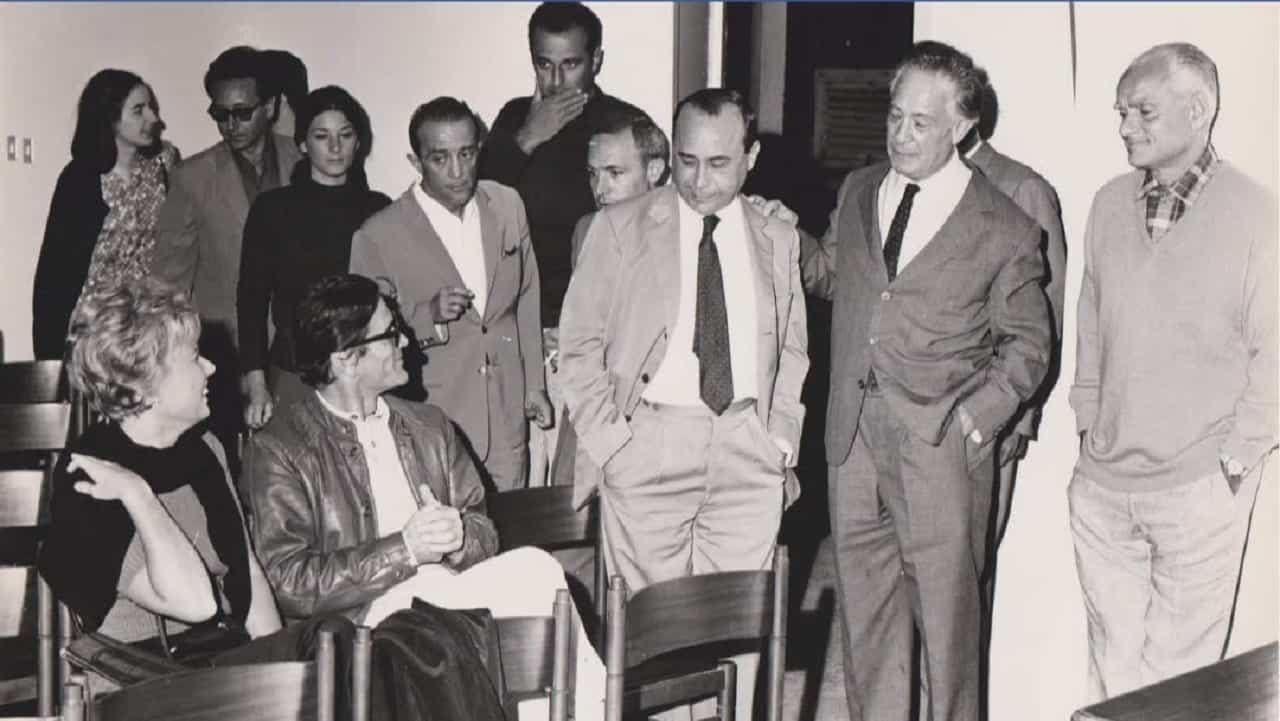
This form of distortion, which downplays the social and political significance of communist movements by negatively twisting their characteristics or radically altering their actions and attributing them to other factions instead, is typical of Italian political discourse following the collapse of communist regimes and parties. Pier Paolo Pasolini is perhaps the figure most at the centre of these dynamics. Current mainstream analysis of Pasolini is often a twisted legacy of his words and thoughts, and confronting it would mean dealing with a long thread of “despite”. Despite being a Marxist - even a non-aligned and independent one, as he defined himself - he is often remembered as a figure somehow beyond the right-left divide; despite being a fierce critic of police brutality and the role of law enforcement in defending class interests, his poem The PCI to the Young!! is always quoted as a blind support of “proletarian” officers against “bourgeois” students and protesters[3]; despite personally beating up a fascist who was contesting the premiere of his 1962 movie Mamma Roma, he is one of the leftist figures, alongside Antonio Gramsci or Hugo Pratt, that many neo-fascists have tried to claim as their “ideological benchmarks”, often using fake quotes or distorted excerpts[4].
Certainly, Pasolini’s thought is not always linear, and his taste for paradox and provocation is both a powerful rhetoric means and a possible source of misunderstandings and double entendres; but this spectre of an “anti-antifascist” Pasolini simply vanishes when fully reading one of his articles or books. The report of his 1966 trip to New York is probably one the best “ghost-busters” one can look upon.
«Everything is about to begin»
In spring 1966, Pasolini was suffering from a severe ulcer which confined him to bed for a month. During his convalescence, he reread Plato’s dialogues and began sketching out the six tragedies that would constitute his theatrical output. Most of these remained unpublished, though some were adapted into films, such as Pigsty[5]. During this period, he also started writing the screenplays for Theorem[6] and Oedipus Rex[7]. The themes of reworking and modernising Greek tragic thought and reflecting on the upheaval of bourgeois customs and mentality amidst the decline of the peasant world and the rise of the industrial world seem rather distant from New York and the United States; yet Pasolini’s reflections on his first journey across the Atlantic, summarised in an article entitled Civil War[8], cannot be fully understood without reference to the ideas and trajectories the director had been pursuing in the preceding months.
In September 1966, Pasolini travelled to the US to attend the New York Film Festival: he wandered around the Big Apple for about ten days, and his encounter with the United States was, to say the least, electrifying. Above all, it is the New Left – with its pacifism, opposition to the Vietnam War and support for the civil rights movement – that stirs and positively unsettles Pasolini, who recognises the same joyful and frenetic atmosphere in 1960s America as in the partisan liberation struggle. Europe is old, stale and cynical: Pasolini senses this with weariness and disgust in the world outside himself, but also within himself, as an isolated man withering away with his «repugnance to speak both of commitment and lack of commitment»[9]. By contrast, the United States is vibrant, joyful and brimming with infectious enthusiasm. While Europe seems to have reached its zenith, America appears to be on the cusp of a new beginning.
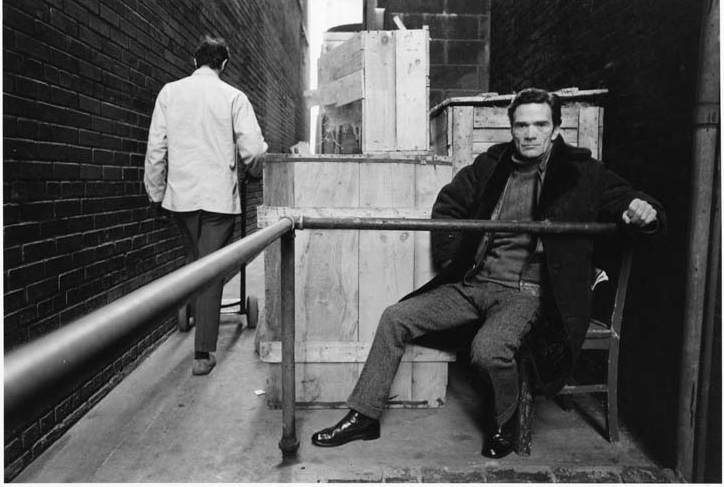
However, this hopeful political vitality does not stem from Marxism. On the contrary, class consciousness is absent in the United States. What drives this intense vital flow is a «long, contorted road of an enormously complex operation»[10], that could be defined as moralism, idealism, or spiritualism. It is the exact opposite of materialism: a form of idealisation and abstract, spiritual reflection that almost ennobles everyday reality. It leads Americans to conceive of an extremist, mystical form of democracy and commitment, whose most accomplished example is perhaps pacifism. In this sense, «Americans [...] always need to idealise»[11]. It is precisely this overwhelming spiritual surge that gives rise to an explosive revolutionary spirit, albeit one that appears radically different - almost incomprehensible - when viewed through a European lens. Pasolini, whose poetics lie at the intersection of the sacred and the political, is enthralled by movements that embrace the slogan «You gotta throw your body into the fight»[12].
Pasolini highlights a development that is almost scandalous for European Marxism: starting from premises that are radically different - if not completely opposed - to Marxist ones, one arrives at conclusions that build upon and go beyond the canonical Marxist ones. The absence of class consciousness (which prevent the working class to perceive themselves as such) ultimately results in this spiritualist refusal of consumer society manifested by beatnik and hippie movement: i.e., the refusal of what is, according to Pasolini or other theorists such as Marcuse, slowly turning European working class into an inoffensive social segment whose ideals and habits are basically bourgeois. Here lies the revolutionary key feature of American society. It is also significant that Pasolini begins the article by emphasising that the United States is a more revolutionary country (rather: one more pervaded by the overwhelming force of revolution, the “real movement which abolishes the present state of things”) than the countries of the Soviet bloc. In the latter, the revolution did not continue after the seizure of power and the working class is still excluded from decision-making and participatory processes.
For Pasolini, the United States is therefore a cosmos seething with contradictions and paradoxes: an anti-Marxist yet revolutionary society, both in practice and in potential; a society without class consciousness yet with extraordinarily powerful trade unions; a society that does not seem on the brink of civil war yet where one can sense the air of «the eve of great things»[13].
The issues of race and migration play a crucial role, not just in shaping struggles and material conditions, but in the formation of an US ontology. According to Pasolini, US anti-communism, driven by the fear that Marxism would homogenise individuals, stems from an intense desire for homogenisation, akin to a Freudian sublimation mechanism. There is no such thing as the “average American”: they are all immigrants, ashamed of their «different and inferior origins»[14], simultaneously craving something that can simultaneously unify and differentiate them, bring them together and prove that they are better than anyone else. It is precisely in this splitting that lies individualism, that lies racism.
The Wretched of the Earth
Therefore, the core of American society - of its dreams and nightmares, as well as the new life springing from the New Left’s struggle - is the racial issue; and Pasolini clearly highlights that it is impossible «to measure enough, in all senses, the range of the Black problem»[15].
What truly fascinates Pasolini about the New Left is the thousands of students who head south to join the Civil Rights struggles without seeking the limelight or taking up too much space. In this connection, Pasolini sees the heart of the New Left, which, on closer inspection, «does not exist, it is only an idea, an ideal»[16]. However, this ideal is capable of transcending itself and becoming a material reality. Indeed, the movement’s crucial claim — and the fundamental reality of the United States — is that the racial problem has not been resolved by civil rights alone, and that it is a social and political issue, not an abstract ethical one. Pasolini’s analysis is based on two central considerations. The first is that the fundamental characteristic of American society is underdevelopment rather than technological development or neo-capitalism. In this sense, New York is the colonial city described by Fanon in The Wretched of the Earth: a Manichaean, divided space in which the most advanced forms of capitalist development coexist with power over the bare lives of the colonised, the credit institutions with slavery, and the Empire State Building with the Bronx. Racial capitalism is not confined to “exotic” spaces; rather, it represents the most intimate and profound dispositif underpinning Western society.
Secondly, the Black question concerns poor white people - those who, while theoretically representing the natural allies of their racialised counterparts, in reality form the front line of the racist camp. It is also the question of the Third World: the «peasant world [...] appearing on the threshold of history (with a foot in prehistory)»[17]. Following the victories of the Cuban and Algerian revolutions, New York, the belly of the beast, has become the epicentre of decolonial struggles.
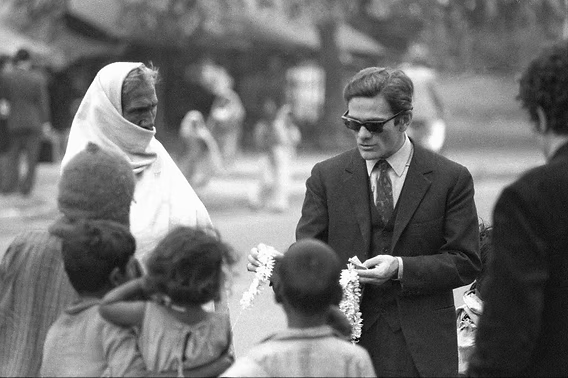
While the term “prehistory” may seem outdated, inaccurate and even racist, it is worth emphasising that for Pasolini it can denote a complex set of eras. “Prehistoric” can refer to a time before industrial society, when the peasant world was not yet swept away by capitalism; but, in the context of decolonial struggles, «the fire of a new Prehistory»[18] heralds the dawn of a new world. Also, considering how contemporary society produces alienation and dehumanisation, “prehistory” is, in a sense, “meta-history” and speaks of a human spirit beyond time that is threatened by the fumes from the chimneys. The distant past speaks of the future and of an eternal present, just as New York and Nairobi are more deeply intertwined than one might initially think.
During those same years, Pasolini was working on a monumental project that would never be completed: a modern reimagining of Aeschylus’s Oresteia, a trilogy of tragedies recounting Agamemnon’s return from Troy, his murder at the hands of Clytemnestra and Aegisthus, and the subsequent revenge taken by Orestes and Electra, the children of Agamemnon and Clytemnestra, against their father’s murderers. The decisive moment of the story occurs in the third tragedy, The Erinyes, which takes its name from the avenging deities who persecute Orestes for his crime of killing his mother. Orestes’ trial depicts the transition from archaic to classical Greece, from the divine world to the human world of law, and the birth of democracy. As part of this transformation, the Erinyes become the Eumenides and cease to persecute Orestes: the power of reason and modernity has appeased and subjugated the divine, conquering and anthropizating nature. For this reason, Pasolini intended to set the drama in Africa, a continent undergoing decolonisation where archaic and colonial societies were giving way to an unwritten future. Pasolini never made the film, but he published a documentary about the process of conceiving it and his location scouting and casting trips to Uganda and Tanzania[19].
Appunti per un’Orestiade Africana is a perfect illustration of Pasolini’s contradictory and oxymoronic character. In the same work, we find precise and reasoned observations on the ongoing industrialisation of Africa without any paternalism or exoticism, and, at the same time, we are confronted with the slippery notion of presenting Africa as a single, vast country. Ultimately, it is the film itself that offers this critique. Pasolini interviews some African students at the University of Rome La Sapienza and, while discussing his film with them, is met with harsh criticism from an Ethiopian student who reminds him that Africa is a continent, not a nation, and that the film risks being an empty intellectual exercise incapable of grasping the truth of things. In an age so accustomed to responding - often under false pretences - to criticism in real time, it is striking to see how Pasolini includes a scene in a documentary in which he is challenged, and in which he appears to be unequivocally in the wrong: it is precisely this coexistence of opposites that makes the film great.
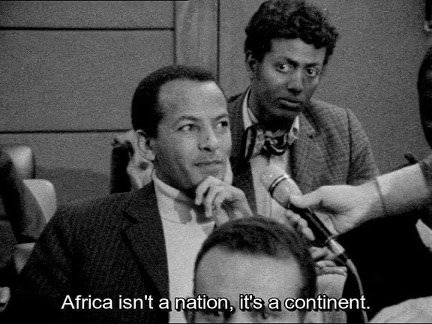
However, it has to be underlined that, for Pasolini, Africa isn’t a mere geographical definition, but rather a conceptual framework, whose extent is quite similar to that of “Global South”: as he wrote in La Resistenza negra, «The concept “Africa” is the concept of an extremely complex lumpen-proletarian condition that has not yet been harnessed as a genuine revolutionary force. And perhaps this concept can best be defined by identifying Africa with the entire Bandung world, Afro-Asia, which, let us be clear, begins on the outskirts of Rome, encompassing southern Italy, part of Spain, Greece, the Mediterranean states, and the Middle East»[20].
Based on this definition, Pasolini considered the United States to be an alternative setting for his Oresteia, and he also considered setting the story in Africa and presenting it through music rather than words. He was planning to entrust the soundtrack to two African-American jazz singers, further intertwining the history of the diaspora and the reality of colonialism - a universal phenomenon rather than geographical otherness. Therefore, Aeschylus, Fanon and Malcolm X point to the same trajectory: it is colonialism and its apocalyptic consequences that lie at the heart of American society.
Apology of the oxymoron
One of the main sources of information about the 1966 trip is the writer and journalist Oriana Fallaci, who was a friend of Pasolini’s and interviewed the poet during his stay in New York[21]. The interview, published in L’Europeo, paints a picture that is both similar to and radically different from that described by Pasolini himself in Civil War: The events mentioned are the same, demonstrating the profound impact they had on the Friulian poet, but they are viewed quite differently. For instance, both accounts feature the sight of three young people with guitars singing protest songs at the edge of a pro-Vietnam War march. However, in Fallaci’s account, the epithet “neo-Nazis”, with which Pasolini describes the marchers, is absent. Instead, Pasolini’s reaction is depicted as a sense of emotion regarding the three’s genuine, courageous, and somewhat naïve nature, rather than the political significance of their action. Although Fallaci expressed abhorrent racist and Islamophobic views in the final years of her life, she was still a long way from her senile turn at the time of the interview, and this different perspective therefore seems to be motivated not so much by radical ideological differences, but by a distinct and contrasting focus on the human dimension.
In Fallaci’s account, another side of Pasolini emerges: the man who, much to Fallaci’s surprise, finds the worn, flashy jackets of young Americans elegant because they are full of life and authentic, and who rushes out to buy a few. This is the same man who will never wear them in Rome because he is «obsessed with the fear of being recognised, criticised and stared at». He is a fragile creature who is forced to eat only fruit and drink only milk, «feeding himself like a baby». He has a pensive and moved gaze directed at an alcoholic tramp and at the people who avoid him without deigning to glance his way, and he then wonders whether this indifference is monstrous or a higher form of compassion. Fallaci portrays Pasolini with great intimacy: she is concerned about his dangerous night-time excursions into the slums and, with a hint of mischief, repeatedly notes how all her Marxist friends, despite their prejudices, have fallen in love with America. She seems to grasp certain facets of her friend’s character and is astonished by his observations that poverty is the defining feature of New York. Anyone who has seen Appunti per un’Orestiade Africana and listened to Pasolini describe the landscapes and actors he would have liked to include will have no doubt that the strange mixture of frivolity and depth, cynicism and naivety, paternalism and empathy is absolutely authentic. The man portrayed in Un marxista a New York is the same man who wrote Civil War.
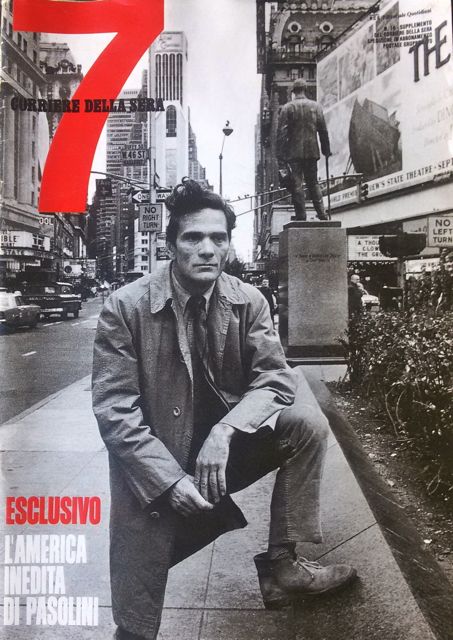
The coexistence of such divergent trajectories as to be nearly mutually exclusive is by no means coincidental; rather, it lies at the heart of Pasolini’s work and life. Even reading Civil War leads the reader to grapple with viscerally opposing emotions and reactions. Some of his account of people wandering in the streets are, to say the very least, offensive and racist, especially when seen with today’s glasses[22]; yet, when Pasolini describes his encounter with some Black Panther militants and notes how they shook his hand with suspicion due to his whiteness, there is no trace of compliance or fetishization, but rather respect and warm admiration. Pasolini is a complex, multifaceted, paradoxical author: his taste for the provocative and the Marxist affirmation of dialectical reality – the ceaseless motion of the unity of opposites - intertwined with his love for self-contradiction and self-renunciation. He is not afraid to revisit his positions or contradict himself, even with regard to the United States. The hopeful picture he painted in 1966 was destined to be short-lived: by the time he returned to New York in 1969, the city of Ginsberg and Dylan was a thing of the past; the vital, subversive energy of the protest movement had become folklore, «the splendid scale of a snake that had slithered away, underground»[23]. It’s no coincidence, then, that Pasolini himself identified his own poetics with the figure of speech of syneciosis: namely, a particular form of oxymoron, in which two contrasting qualities are attributed to the same subject.
Pasolini’s political views are quite clear and it is impossible, for an honest reader, to attribute him the somehow fascist-y or “anti-conformist” aura that Italian contemporary mainstream discourse has attached to him. Yet, to really understand him and his poetry requires also this acknowledgement of his syneciosis core. Reading Pasolini’s work 51 years after his death precisely means to accept and move from this contradictory nature; it means, in a certain sense, to retrace his steps, to walk alongside him in New York, in a ten-day trip whose absurd and ambitious goal was trying to understand the deep heart of a cosmic phenomenon.
Bibliography
Fallaci, Oriana (1966), Un marxista a New York, L’Europeo, 42.
Pasolini, Pier Paolo (1969), Incontro col Living, Tempo.
Pasolini, Pier Paolo (1988), Heretical Empiricism (or. title Empirismo eretico), translation by Ben Lawton and Louise K. Barnett, Bloomington and Indianapolis, Indiana University Press.
Pasolini, Pier Paolo (1999), Saggi sulla letteratura e sull’arte, Milano, Mondadori.
Sciascia, Leonardo (1969), Salt in the Wound (or. title Le parrocchie di Regalpetra), translation by Judith Green, New York, The Orion Press.
Trento, Giovanna (2015), «La pianta trapiantata, dalle radici scoperte»: diaspora transatlantica e presenze afroamericane nell’opera di Pasolini, in Oltreoceano. Pier Paolo Pasolini nelle Americhe, edited by A. Ferraro e S. Serafini, 10.
Wu Ming 1 (2015), La polizia contro Pasolini, Pasolini contro la polizia, Internazionale.
Wu Ming 1 (2018), Pasolini e il suo orrore per ogni fascismo, Giap.
Credits
Film Oedipus Rex (or. title Edipo re) by Pier Paolo Pasolini, 1967, Italy (Alfredo Bini).
Film Theorem (or. title Teorema) by Pier Paolo Pasolini, 1968, Italy (M. Bolognini, F. Rossellini).
Film Pigsty (or. title Porcile) by Pier Paolo Pasolini, 1969, Italy (Gian Vittorio Baldi).
Film Appunti per un’Orestiade Africana by Pier Paolo Pasolini, 1970, Italy (Gian Vittorio Baldi).
Film Baarìa by Giuseppe Tornatore, 2009, Italy (Medusa Film).
Notes
[1] Sciascia, Leonardo (1969), Salt in the Wound (or. title Le parrocchie di Regalpetra), translation by Judith Green, New York, The Orion Press, p. 54-56.
[2] Film Baarìa by Giuseppe Tornatore, 2009, Italy (Medusa Film).
[3] Wu Ming 1 (2015), La polizia contro Pasolini, Pasolini contro la polizia, Internazionale.
[4] Wu Ming 1 (2018), Pasolini e il suo orrore per ogni fascismo, Giap.
[5] Film Pigsty (or. title Porcile) by Pier Paolo Pasolini, 1969, Italy (Gian Vittorio Baldi).
[6] Film Theorem (or. title Teorema) by Pier Paolo Pasolini, 1968, Italy (M. Bolognini, F. Rossellini).
[7] Film Oedipus Rex (or. title Edipo re) by Pier Paolo Pasolini, 1967, Italy (Alfredo Bini).
[8] The article was originally published with the title L’America di Pasolini in Paese Sera, a left-wing newspaper based in Rome, and is now part of Pasolini, Pier Paolo (1988), Heretical Empiricism (or. title Empirismo eretico), translation by Ben Lawton and Louise K. Barnett, Bloomington and Indianapolis, Indiana University Press.
[9] Pasolini, Pier Paolo (1988), Heretical Empiricism, p. 148.
[10] Pasolini, Pier Paolo (1988), Heretical Empiricism, p. 147.
[11] Ibidem.
[12] Pasolini, Pier Paolo (1988), Heretical Empiricism, p. 149.
[13] Pasolini, Pier Paolo (1988), Heretical Empiricism, p. 143.
[14] Pasolini, Pier Paolo (1988), Heretical Empiricism, p. 146.
[15] Pasolini, Pier Paolo (1988), Heretical Empiricism, p. 145.
[16] Pasolini, Pier Paolo (1988), Heretical Empiricism, p. 143.
[17] Pasolini, Pier Paolo (1988), Heretical Empiricism, p. 145.
[18] Pasolini, Pier Paolo (1963), Poesia in forma di rosa.
[19] Film Appunti per un’Orestiade Africana by Pier Paolo Pasolini, 1970, Italy (Gian Vittorio Baldi).
[20] In Pasolini, Pier Paolo (1999), Saggi sulla letteratura e sull’arte, Milano, Mondadori.
[21] Fallaci, Oriana (1966), Un marxista a New York, L’Europeo, 42.
[22] Pasolini, Pier Paolo (1988), Heretical Empiricism, p. 146.
[23] Pasolini, Pier Paolo (1969), Incontro col Living, Tempo.